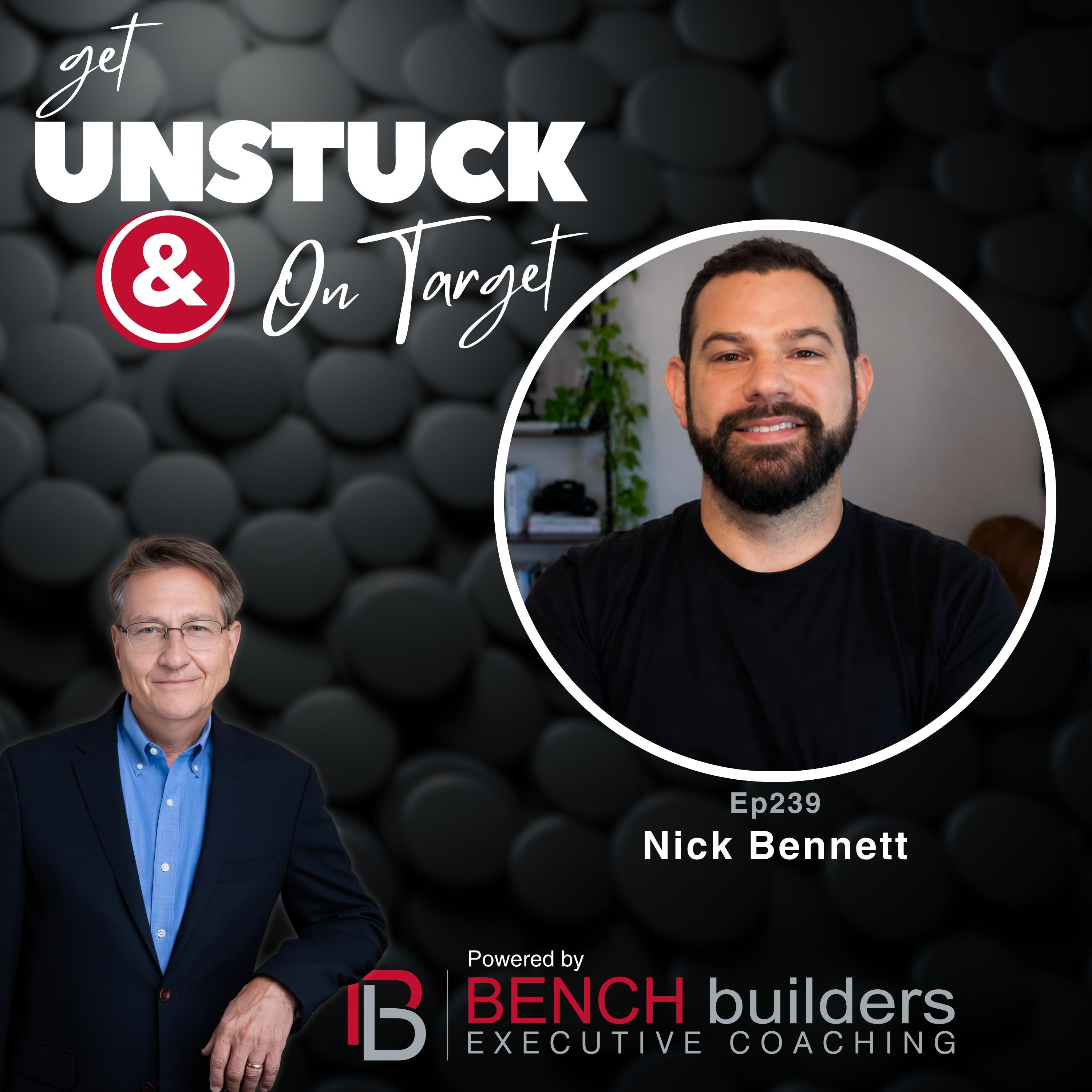
Ep239 Nick Bennett—Bridge the Recognition Gap and Turn Your Expertise Into Predictable Growth
Schedule a Game Plan Intro Call Here
This 15-minute call is a chance for us to connect briefly and see if a full Game Plan Session is the right next step. No prep required — just bring your goals or questions, and we’ll explore whether a deeper dive makes sense.
______________________________
Do you know the exact problem you solve? And can you say it in a way that makes the right people stop and take notice?
In this episode of Get Unstuck & On Target, host Mike O'Neill sits down with Nick Bennett, co-founder of Duo Consulting, who works with solopreneurs and independent consultants stuck below their growth ceiling because their value isn't clearly recognized, packaged, or claimed.
Nick, with experience working alongside more than 100 solopreneurs and micro-agency owners, introduces a concept he calls the recognition gap: the distance between the value an expert actually creates and the value the market clearly sees. In a grounded, practical conversation, Nick and Mike dig into why capable professionals stay trapped in referral dependency loops, why expertise alone doesn't create market recognition, and what it actually takes to build a business where the right clients find you.
Three key topics to look out for:
- The CP3 framework: why clarifying the problem you solve, the person you solve it for, and the process you use is the foundation of everything else
- How mindset and limiting beliefs quietly determine who breaks through the revenue wall, regardless of their follower count or bank balance
- What "marketing the problem" actually means, and how it creates a categorical difference that removes comparison shopping entirely
Nick Bennett 0:00
Starts with clarifying the problem you solve. I think that's probably one of the most important questions in business, and not enough people know the answer to it. If you can't articulate the problem you solve, it's gonna be really hard for you to market yourself your business and explain what you do in a way that matters to anybody.
Mike O'Neill 0:18
Welcome to get unstuck and on target, the weekly podcast that offers senior leaders insights and strategies to not only lead with confidence and vision, but also to achieve groundbreaking results. I'm your host, Mike O'Neal I coach top level executives on the power of ethical leadership to forge teams to be as united as they are effective in each episode, join me for insightful conversations with leaders just like you providing practical advice to help you get unstuck and propel you and your company forward. Let's get started. My guest is Nick Bennett. In this conversation, we get into something I see all the time with leaders, consultants and solopreneurs. They're doing solid work, they're respected, they're busy. But when someone asks, What exactly do you do, the answer gets fuzzy. Nick calls this the recognition gap, the gap between the value you actually create and the value that others clearly see. What I appreciate about Nick's work is that he doesn't talk about hustle or louder marketing. He helps people clarify the problem they solve so that their value is obvious, repeatable and confidently claimed. If you're successful on paper, but feel something's not quite aligned, this conversation will help you think differently about what matters most. I see this all the time with capable leaders, consultants and solopreneurs, they're doing solid work. But when someone asks, What exactly do you do, the answer gets fuzzy, not because they lack expertise, because they're too close to it. My guest today is Nick Bennett. He is the co founder of duo consulting. Nick works with solo photos and experts who are stuck below the growth ceiling because their value isn't clearly recognized, packaged or claimed. What caught my attention about Nick's work is this idea he calls the recognition gap, the gap between the value you actually create and the value that the market clearly sees. And that gap, it quietly creates pricing pressure, exhaustion and stalled growth. And while Nick often sees this with consultants and solopreneurs, I see the very same gap inside leadership teams, where values exist, but direction, ownership and confidence lags behind. I invited Nick on because leaders don't usually need more expertise. They need clearer recognition of the expertise that they already have. Welcome. Nick, what's up? Mike. Nick, that was a longer introduction that is somewhat typical, but I really want to make sure that I kind of set the stage, that what we're going to talk about this notion of the recognition gap. I love it when you talk about that. What do you mean by that?
Nick Bennett 3:30
Well, I think all consultants, and anyone who's been doing this a while, whether you call yourself a consultant, an advisor, a fractional solopreneur, doesn't really matter, but I think we all have felt this thing where you're really good at the thing you did, but If only more people knew it. And what we find is that most people in our situation end up relying on referrals to build their business, and they end up in this little doom loop where they get some referrals just in time. They get really busy, and as those projects or those deals tend to come to their natural conclusion, or whatever they may be, they're stuck wondering, Will another referral show up right on time? And so the recognition gap is our way of kind of articulating this entire cycle where they're like, we're too beholden to other people, we're not recognized as the experts that we should be in a more in a more public way that would help us stabilize our revenue, create a more predictable business.
Mike O'Neill 4:38
So how does you and your colleagues at duo consulting do just that.
Nick Bennett 4:44
Oh, well, it's it's a process, but we really anchor into what we call the CP three framework, and it starts with clarifying the problem you solve. I think that's probably one of the most important questions in business, and not enough people know the answer. To it all right, if you can't articulate the problem you solve, it's gonna be really hard for you to market yourself your business and explain what you do in a way that matters to anybody. Beyond that. We need to be able to find clarity on the person you solve that problem for, or the when you say person could be indicative of a business type, or something like that, but just the person, the person you're selling to, and then beyond that, it's the process that you use to solve that problem. So everything anchors on the problem. Everything, if you can't get that right, or you can't articulate that, it's a it's it's going to be a slog. You
Mike O'Neill 5:41
know, I was intrigued when you were describing how business owners oftentimes revert to that vicious loop being very dependent on referrals. There's nothing wrong with that, but what you're saying, it's not predictable.
Nick Bennett 5:58
I'm saying it's a really tough way to live. Referrals are not referrals are not inherently a bad thing, but you can't quite drive referrals in the way that you can drive other types of marketing. Now, referrals are also not typically bad for a lot of people. When you start doing something really specific, and you have a system and a play that you run, and people send you a referral who knows nothing about you. That's not a fun sales process. Those are generally bad fit leads. They end up showing up being like, convince me, sell me. Tell me all about this if I know nothing. And they become bad fit leads, and they either don't close, or you have to bend and break your entire model to sell something custom to fit their needs. And so it's really becomes a lot less fun when you're sitting there relying on referrals, when you can just go get business in multiple other ways. I
Mike O'Neill 7:00
love to go back to this notion where you kind of say that sometimes you have found, maybe oftentimes experts, they're too close to their own expertise to see what's really valuable. What do you think that's the case? Why has that become a blind spot, especially for high performers.
Nick Bennett 7:24
Think about knowledge from the spectrum of obvious to non obvious, right? What is obvious to you could be highly non obvious to someone else, and in a lot of cases, it is, and that's why people hire you, or hire people like me or any consultant for that matter. But when you're so close to it. You've heard the phrase. Maybe it's difficult to read the label from inside the jar, yeah? Because most people in our situation, you're so close to the work, how do you don't know what's interesting about it? Because it's very obvious to you. You go, this makes like everybody knows. That is a common phrase we hear when we hear when we do our work, with our with our clients, oftentimes they're they're explaining to us their systems and their frameworks and all their thinking. We'll wrap that in this idea of your point of view. Just how do you see the world, and how do you help other people go from where they are to where they're trying to be? And it feels so run of the mill to them, because they've been doing it for so long, and when we have to point out that that is, in fact, very interesting. Nobody's talking about this category or this situation or this problem in the way that you're talking about it, you're really close to this thing. And we have to be able to shine a light on that and remind them that nobody, not everybody's out there, is thinking about this the way that they are, and they don't think about it as often as they do. So to be able to highlight that also is really empowering for people to like, Oh, wow. Like I I do have something interesting to say. I do have the ability to like, help other people think about and see the world in a different way. And when you can make that change for somebody in the world, that's when we say this idea of like market the problem, you can become their solution, right? When you help people see the world in a certain way, you're the only option for that.
Mike O'Neill 9:09
Yeah, Nick, you and I have had similar conversations in the past. I've gotten a sense that you seem to have kind of a gift for this, and that is, people might describe what they do, and it seems real commonplace, but you find things that are interesting. You help open their eyes to things that they may or may not see. Would you call that kind of a gift that you're able to do that?
Nick Bennett 9:38
Thanks, I guess so. I've never quite thought about it that way. Sometimes, see, it's hard for even for me, to read the label. It might be a gift. I just think I it's let me, let me. Even back up a bit. It is hard to explain why some people. Are really good at what they do. Because the answer is like, well, when you just know, you know, like, and this is what makes transferring some of the knowledge from the work that people like us do any consultant for that matter, hard, if it's not super tactical, right? The work is, it's very like, it's high EQ in the way that you have to navigate that situation. So all that to say is like, is it a gift? I mean, maybe. But I also just think that being having worked with now over 100 solopreneurs or micro agency owners, you start to identify the patterns of things that hit and things that work and things that don't, and different lot different lines of logic and different ways of framing a problem that are going to make a difference, or the ones that don't. And there's we've started to develop frameworks to, like, demystify it, so it's less like Nick and my business partner Erica and I like just kind of gut checking it and going, we know, but making it more concrete so that other people can do it themselves. And we've written tons of we're writing mini books on these ideas right now and all these trying to codify all these frameworks. And the goal is to, like, produce these so that other people can do it on their own and start to see it themselves. So it's a long winded answer to a brief question, but I think the idea is, like we all have that part of us in the work that we do, for sure.
Mike O'Neill 11:35
Well, if you do your job right, you see that which they cannot see. I see that in my role as a coach. You know Nick, you've taken on a partner. You're doing this. You're finding that there's some patterns. You've been doing this a lot, and with repetition, there may become more predictability. But for those who are listening, trying to say, all right, how do I differentiate Nick and and duo from all the other folks out there. What is it that you all do that really does, in fact, differentiate
Nick Bennett 12:12
us or our work or our clients? What do you
Mike O'Neill 12:14
I think I'm more looking at business owners can be overwhelmed by all those moving parts. And when they align with a quote marketing company, what they are told is you need to do the following marketing steps. I just get the impression in talking to you that what you all do is different, and it's different and it works.
Nick Bennett 12:41
Yeah. I mean, we've been, we've been blessed, and that we've, we've worked with some really great clients, and they've all, they've they've seen some really remarkable results with our program. So to the question about, like, well, what's different? Back to what I said earlier, like, market the problem, our ability to understand and articulate the problem our buyers face is what differentiates us, because we don't do much selling at all. We don't our ability to help people understand and see the problem, the way that we see it, like the idea of the recognition gap, is us showing other people that we get it. We understand exactly where you're at, we know where you're at, we understand where you've come from. We understand where understand where you're trying to go. We understand that the main blocker between where you are and where you're trying to go. And so there's very little comparison between us and other consultants. When when people come in, they're not like, well, I'm looking at you and all these other people, because our point of view is very clear. So it might be that we get it becomes a categorical difference, like it's a choice between us and other categories of solutions. Some people look at us and they go, Well, we're either going to hire you or we're going to hire this outbound growth firm. It's like, Well, those are two entirely different things. It's not like us or other growth consultants, because our point of view is clear. The problem that we solve is clear. They understand that we get it better than anybody else, and so that's the that's not only what we encourage everyone else to do. That's like the service, the service that we provide to our clients and helping them become known for that problem that they solve in a more, more widely known just outside of that immediate network. That's the magic. And it's, and it's actually not magic at all. It's, we call it market the problem
Mike O'Neill 14:34
in marketing the problem. And you reduced it to just a very, very few words. I also get the sense that the best client for you has been folks that have experienced growth, but they're beginning they kind of start to hit kind of a ceiling, if you would. Am I remembering that correctly?
Mike O'Neill 14:59
Do.
Nick Bennett 15:00
Yeah, absolutely. So the people that we work with primarily are generally somewhere between 35 and 60,000 a month in recurring revenue, and they've hit they've run face first into what we call the revenue wall, and it's usually because there there's some layer of either standardization, delegation or automation that needs to take place in order to get them over the wall. That's really the that's really where we are, and most of the time it ends up being solos or independent consultants who they don't want to go on and build this, you know, super ding dong agency that most people cringe at the word agency. They and they will have no desire to build one. But we've kind of found this place, what we call the micro agency, which is really like you as the founder, or a couple of founders, and maybe a very small team of highly vetted contractors that end up helping these people clear the clear that revenue wall. And most of the time they get back their life like they'll end up working, you know, they're working 50, 6070, we have some people working 90 hours a week, which is bananas, it's it's preposterous, but we help them get that back and and sometimes they want to earn a little bit more money
Mike O'Neill 16:27
while they do
Mike O'Neill 16:28
it. I would think most times they do just that. Y'all as a as duo consulting, y'all been partner. How long
Nick Bennett 16:38
we started? So the it's actually quite a interesting story. Erica and I had met in a small community for consultants a couple years ago, and she ended up becoming a client. And after that, she she saw success with the work pretty quickly, which was cool, and we started to see this problem emerge, which was there would be a lot of people that would come to her for her work, but they would be too early, and they actually needed the thing that I did. Like the her best clients were clients that went through or had already done the work that I do, whether they went through me or they did it independently or whatever, and then vice versa, I would hit a wall with my own clients. Say, I can't, I've taken you as far as I can take you, and you really need someone like Erica. And so we kind of saw this pattern independently. We talked about it, and we've created a we kind of did, like a trial run, and we made a small group cohort in November of 2024 and we launched that was called Full Stack solopreneur. And it was a, it was a group program for for these solopreneurs. And we did that for a year. We just closed it down this past November, and we realized going through that work together, that we were like this clearly works. This must this not only like should exist, it has to exist. And so in May of 2025, we formally partnered in the services. So we took that cohort and that group based program that we were running, and we turned into like a done for you service, and we launched, we rolled that out in May. And it's been now, you know, attended January, so it's been almost a year now, of us doing that. So it's been quite the ride, but it's been, it's been fun, I would say, taking on a partner. People have good experiences with this. Some people have bad experiences. Eric has had a bad experience with a partner in the past. She's She doesn't hide that fact, but this one's working out, and so it's been a ton of fun. And it's made, it's made building, building something, it's given a lot more energy. You know, it's weird when you're when you're by yourself, a lot kind of realize that you do miss, or I missed, at least having someone else around to help talk you tend to talk yourself in circles, right? Yes,
Mike O'Neill 19:00
and I'm accused of doing that in other settings as well. I guess I'm very happy that you have found a business partner that works well, and that what you all have expertise in is so complimentary. And what I really am keying in on is the relationship started as a client relationship, and obviously it evolved to that point. You know, you have had opportunity now to work with, I think you said 100 plus, if you were to step back and say, here's just some general observations that I see going on out there. You work a lot with solopreneurs or micro agencies and alike, I think, give us the viewers and the listeners a little bit of what is it you see from your vantage point? What's going on and where do you see this going? Does that comment question makes sense? If I
Nick Bennett 19:56
should say yeah, the number one constraint in. Um, is most people can't get out of their own way, and that's like kind of a tough that's a harsher way to say it. So I'll say it. I'll say it in more words, which is, we all have limiting beliefs about ourselves and about the way the world works, and our mindset and our ability to change that and change our beliefs, and decide how who we want to be and what we want to believe and the types of businesses we want to build, is the difference between the people who we see go all the way and whatever that, however you define all the way, whatever business you build that serves your life in the way that you want today, not 10 years from now, but today, because your life will change all the time. And those people who really master the mindset side of this work are the people who have the most joy satisfaction. They're fulfilled by they have clients. They love their work makes a difference for their clients. They get paid well, those are the people who go who see it all the way through. And it starts with understanding that our limiting beliefs about ourselves and what we're capable of are the main thing. And if we can overcome that stuff, and that's a lot of stuff that we help our clients too, because here's here's the very raw truth, no matter what level of success you achieve. There are people. We all have limiting beliefs. I have seen clients and peers and other consultants that say I have $100,000 in the bank account, and I'm doing $30,000 a month, and I just don't know if I'm here, if I can cut it like they still feel this way. There are consultants with 100,000 followers on LinkedIn that we work with that still feel like they're like, I don't know if I can pull this off. I don't know if I can do this or if I can get enough business to quit my job. There are consultants with 200 followers on LinkedIn and they're like, I'm just gonna go for it, because they don't have that. They have a different set of beliefs about themselves and who they are and what they're capable of. So it doesn't really matter how much money you have, it doesn't matter how many followers you have. Freedom and this, all of this stuff that you're working for, which is basically, in so many words, Freedom. Freedom starts with you, not your money, not your followers, not none of that stuff you and your mindset and how you believe, what you believe about yourself?
Mike O'Neill 22:24
Yeah, I love how you responded there. I want to put you on a spot a little bit, and that is, you know, this show is about getting unstuck. Was there a moment in your own work where you realized that clarity, not hustle, was the real constraint, and mostly the first week
Nick Bennett 22:46
was that it was the first week. It has a lot to do with how we met. Um, I knew that I couldn't outwork I mean, you can outwork it, but you'll just grind yourself, you'll wear yourself down. And my wife told me very early on she gave me the space to build this business. And when I got laid off, just for some context, I got laid off from my job. And in July of or June of 2023 I don't know what point anymore, June of 2023 I had a night my I had one kid at the time. He was nine months old. My wife was a full time mom. I sort of say joking. I say she works for the boys, and so I had no choice but to make this thing work. And I realized that, like, I'm working a lot, and one day she says to me, a few months in or few, however long into it, she goes, the answers you're looking for are not in your screen. You're working you're staring at your laptop screen all day and all night, the answers you're looking for are not in your screen. And so that really struck me, and what I did was I reached out to a friend, and I just I asked him a question, if he knew anybody that kind of did one thing or the other. And he introduced me to someone, a personal friend, Suzanne Taylor King, and she introduced me to you, and you gave me you, you gave me your ear. And you were like, I think, like you're calm. You gave me calm. And you were like, focus on what you need to focus on. And like, that clarity of just being like, Oh, I'm trying too hard. I'm trying to do too many things all at the same time. That type of situation, that experience that I think redirected me so early on that that one degree course correction in, you know, August of 2023 was the I think if that didn't happen, I don't know where it would
Mike O'Neill 24:42
have
Mike O'Neill 24:43
been. Nick you're kind to say that I actually forgot about that until you just started mentioning that, because I remember we connected very early on in that process. And for those who are listening, who are running big companies, this may not apply, but for people who run smaller businesses. Oftentimes solopreneurs, when we meet sharp people, and I concluded very early on, you're very, very capable. It comes as no surprise that what you all are doing is being very well received. So thank you for the for the comment, does the model you have in place with Duo consulting, can it scale?
Nick Bennett 25:24
Absolutely,
Mike O'Neill 25:25
okay,
Nick Bennett 25:26
that's, that's we re we built this intentionally because we both build businesses that couldn't scale and then businesses that could scale but probably shouldn't. One of the things we teach our clients, and we talk a lot about is like understanding what business you're really in. There are people who are in the traffic business. Those people build very public and flashy businesses. And I say traffic business, like you're selling courses, selling cohorts, or groups, or this or that. Being in the traffic business is a grind. We were in that business, with our with our group program, and you're just constantly creating, you're constantly it's hustling, trying to work super hard to get more people in the group to continue to make money. Erica, my business partner, she's launched tons of courses, and she's made a bunch of money doing it, but it is a grind. She would like, you would you would launch, you'd have this huge influx of cash, and then there'd be nothing until you did it all over. And she was like, it's just too much. So these businesses can, technically, on paper, scale up, but it is a very different business. And so we've intentionally built this one as a relationship based business, slow churn, slow client rotation, much higher margin, much higher revenue, much more stable. We don't need to sell 100 things a day, a month, a year, whatever we can close two or three clients a quarter, and life is good because most clients like stay with us six, nine, sometimes even 12 months, and that business is so much more stable and enjoyable. Now, if the question is, can it scale? Well, now we've built into the system like, how do we actually, how do we horizontally integrate other people into the business? Is there not do we clone ourselves? Do we bring other people in? And let's continue to run point. There's a million different ways to scale it. We haven't decided what we want to do, because we're just having fun running it right now. I'm sure at some point we won't want to be people who run the business, but be people who own the business, and that that will change eventually. But our goals right now are have fun running this thing, and like, I have two kids, and one on the way, she has two kids. So we're just having fun running it, and building, building this thing and and being parents, and so scaling this thing into oblivion isn't necessarily what we're after, but it's, it's just building something we enjoy, and then it's and we're slowly layering in these different ways to delegate and automate much of the process so that we don't have to work ourselves nine to five every day. And I think soon enough, we will probably be mostly out. I think we'll probably be 20% active in the business, and that we are creating content, writing books, doing things that we love, and not doing everything.
Mike O'Neill 28:24
I appreciate that insight. Let's go back to your target clients. How about those listeners who know that they're undervaluing their work? What might be one practical step that they can take this week that might start closing that recognition gap,
Nick Bennett 28:46
clarify the problem you solve. There's nothing more important, there's nothing more important. And if the answer is, we solve lots of problems, we all do right? Everyone solves a web of different problems. Part of the art of doing this and framing a problem for your buyers or for people who need what you have is understanding not what is the most compelling core issue at hand, core problem, and then understanding what are the circumstances or the reasons that problem may exist, or the ramifications of that problem going unsolved and that organization, that level of clarity, that's where you find the juice in marketing, that's where you find the juice in being able to find clients that really, really need what you have, that are really fired up about working with you, and not just anyone, not just any growth consultant or any business coach, but working with you.
Mike O'Neill 29:50
Nick as you know, this was an unscripted conversation. I appreciate your willingness to kind of just kind of go with that flow, for those who are watching, for those who are listening.
Mike O'Neill 30:00
And
Mike O'Neill 30:01
I'm confident there can be some folks who want to take advantage of that kind of that clear, practical guidance that you offer. What's the best way for people to connect with you and learn more about your all's work?
Nick Bennett 30:13
Yeah, you can check us, check me out on LinkedIn is probably the best place you can we we write there almost daily. And we also have a show, and we publish mini books every single month. At how solo scale.com, the mini books are free to the world. They're about six to anywhere between six and 10,000 words on any given topic or framework that we use ourselves to help our clients grow. So they're free to the world. No Santa.
Mike O'Neill 30:40
Is there
Nick Bennett 30:41
anything required?
Mike O'Neill 30:42
Did you include that in the guest intake form? Yeah, perfect. Okay, good. So for those listening, if you want to learn more, we're going to have links to those resources and links on how to reach out to Nick in the show notes. Nick, thank you so much.
Nick Bennett 31:00
Thank you, Mike. It's good to see you,
Mike O'Neill 31:02
man.
Mike O'Neill 31:02
I'm going to close by just ask this question, and that is if today's conversation surfaced a realization that your value might be clearer to others than to it is to you. Don't ignore that. Nick's links there are going to be in the show notes, and let me strongly encourage you reach out to my friend Nick to explore what they can do for you in your business. And if you're a leader who's feeling capable but constrained doing good work without the clarity, confidence and the traction that you want, I'd be glad to help you think through from a leadership perspective, I offer complimentary two hour game plan sessions for leaders who want clarity, not noise. There's no pitch, there's no pressure, just a practical next step. You'll find the links in the show notes to that as well. So for our listeners, thank you for doing the real work that leadership requires, and I hope that this helped you get unstuck and on target. Thank you for joining us for this episode of get unstuck and on target. I hope you've gained insights to help you lead with confidence and drive your organization forward. Remember, at bench builders, we're committed to your success, your leadership excellence and your strategic growth. If you've enjoyed our conversation today, please leave a review, rate and subscribe to keep up with our latest episodes. This show really grows when listeners like you share it with others. Who do you know who needs to hear what we talked about today? Until next time, I encourage you to stay focused on the target and continue to break new ground on your leadership path.
AI VO 32:54
This show is powered by media leads to get your next great podcast produced. Go to media leads, co.com