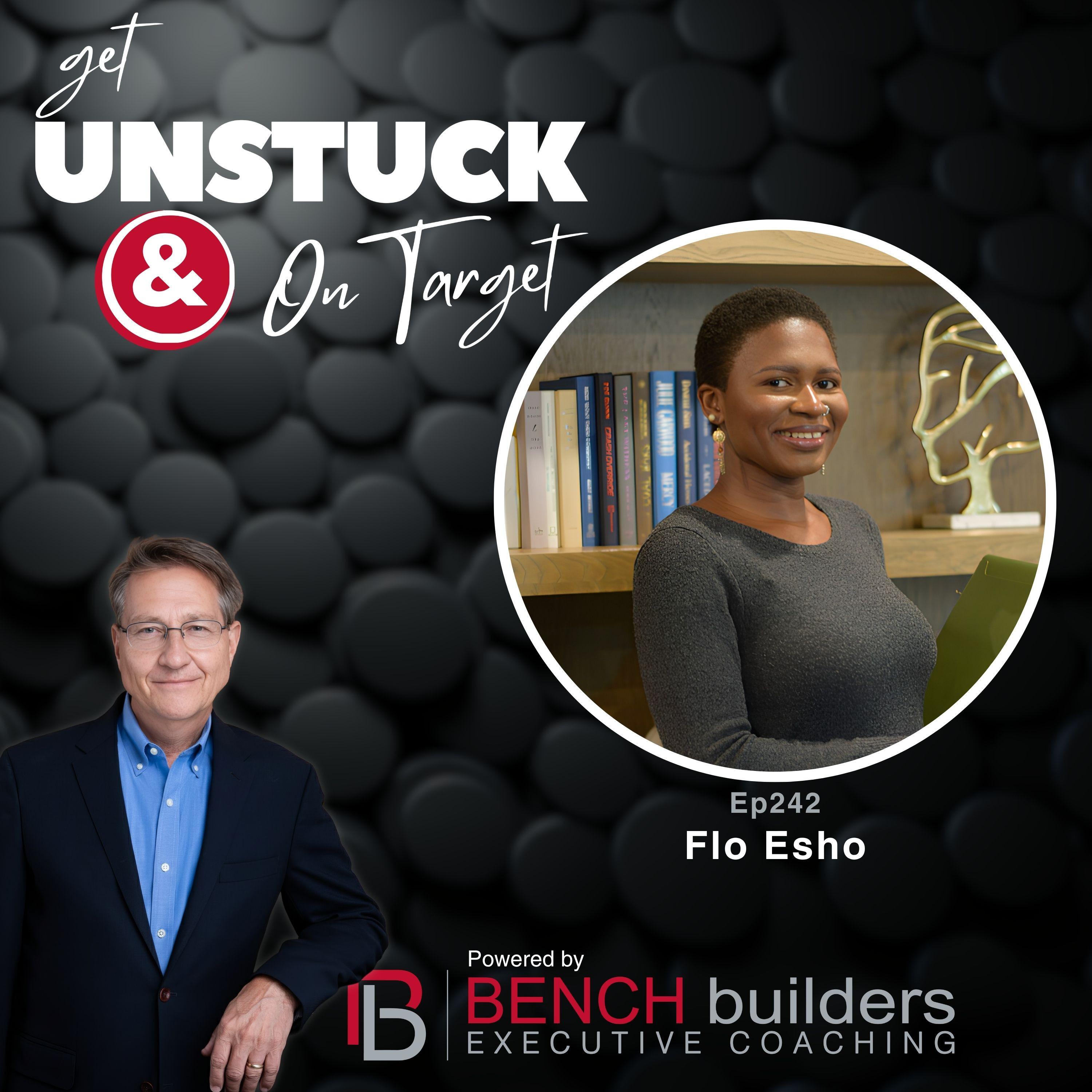
Ep242 Flo Esho—Break the Bottleneck and Transfer Real Trust
Schedule a Game Plan Intro Call Here
This 15-minute call is a chance for us to connect briefly and see if a full Game Plan Session is the right next step. No prep required — just bring your goals or questions, and we’ll explore whether a deeper dive makes sense.
______________________________
Ever hit 9pm and asked yourself what you actually got done today?
In this episode of Get Unstuck & On Target, host Mike O'Neill sits down with Flo Esho, founder of Easy Flow Life, a US-based executive assistant agency that helps founders and senior leaders get out of the day-to-day and back into real leadership.
Flo breaks down the hidden cost of doing everything yourself: the cognitive overload that turns founders into overwhelmed project managers instead of CEOs. She and Mike walk through what a good executive assistant actually handles, calendar, invoicing, inbox, project management, and personal logistics; the difference between task execution and true ownership; and the trust transfer that has to happen before a leader can really let go.
Three key topics to look out for:
- The real cost of never delegating, and why it compounds every single day
- How to tell the difference between an assistant who completes tasks and one who owns outcomes
- Flo's three-step framework for vetting an assistant before you ever hand off real trust
Flo Esho 0:00
I feel like an executive assistant has to know how to manage up. We can't just sit there and be yes people. We have to be able to integrate and be able to bring our years of experience working across different businesses, sizes, structure, complexity, and be able to come and say, this is what you've been doing, this is how we can do it better.
Mike O'Neill 0:19
Welcome to Get Unstuck and On Target, the weekly podcast that offers senior leaders insights and strategies to not only lead with confidence and vision, but also to achieve groundbreaking results. I'm your host, Mike O'Neill. I coach top-level executives on the power of ethical leadership to forge teams to be as united as they are effective in each episode. Join me for insightful conversations with leaders just like you, providing practical advice to help you get unstuck and propel you and your company forward. Let's get started. Most founders think that their biggest problem is time. It's not. It's trust, the inability to let go, to hand off real ownership, not just tasks. That's what keeps good leaders stuck, still at the center of every decision, still the bottleneck in their own business. In this episode, I sit down with Flo Ischaul. She helps leaders stop operating like an overwhelmed project manager and start leading the way that they were meant to. If you ever hit 9pm and you ask yourself, what did I actually get done today, this one's for you. My guest today is Flo Eschal, founder of Easy Flow Life, a US-based executive assistant agency that helps founders and senior leaders get out of the day to day and back into true leadership. Flo's teams takes ownership of execution across business operations and personal logistics, so leaders can stop being the bottleneck, bring structure to fast-moving environments, and see what is needed before it even becomes urgent. Welcome, Flo.
Flo Esho 2:14
Thank you. Thank you for having me, Mike.
Mike O'Neill 2:16
Those who are listening and watching are going to find why I wanted to invite Flo onto the podcast, she's a delightful person, but what I really wanted her to do is help us understand the world of virtual assistants, and I really like to kind of focus most of our conversations around the idea of there really is a cost when you do or do not do something, and namely I'd like to kind of key in on the hidden cost of trying to do everything yourself. I am of the opinion, you tell me if I'm wrong, that most key leaders, they find that they're they're doing them themselves because they think they're the best for the job, or maybe they say, you know, handing things off, it's going to take more time than doing that, but if that is the case, is there a cost, and if so, what is the real cost they're not taking into consideration?
Flo Esho 3:11
Yeah, no, that's a really good question. I actually did a presentation around this exact same topic to a group of women founders not too long ago. I, it is true that when you are initially trying to transfer something that you've always done to somebody else, that first time is going to take a little bit of time, right, because you're trying to take what's in your brain and how you operate and you're trying to give it to somebody else. What people don't think about, though, is the continuity of the cognitive overload that you're putting onto yourself when you don't eventually just let go. So, the hidden cause is that, as the founder of the business, you're unfortunately moving now, like a CEO, but like an overwhelmed project manager, because every single decision has to run through you. You are never able to turn off every like context in your mind, literally every single day, every single minute, and so that's the cost, is that you're the center of everything. You don't empower your team to take ownership of certain parts of the business, and the cognitive overload is eventually every founder gets to this point where eventually your business is going to outpace your capacity, and it's just a, it's just a recipe for disaster.
Mike O'Neill 4:47
So, let's assume folks are listening, and they've kind of said, you know, I've heard about it, but I just haven't gone there. In practical terms, let's first talk about business tasks that you. You and your team can do what is most typical, the kinds of things that a leader says, "I want to have a VA help me do.
Flo Esho 5:11
Yeah, I think some of the, some of the things are client management, right? Like a lot of founders, often there's no buffer between them and the clients, or like between them and, like, their team. They, you know, most founders might have either full-time employees that's working in different parts of their business, or they might have multiple contractors that's helping them out, and there's no buffer between them and that team, and there's no buffer between them and the clients. So an executive assistant who is supposed to function as an extension of you now becomes their buffer, and now they help with the decision making, because you and that assistant have defined what your prioritization structure looks like, what your, what your, what your system flow looks like, so some of some of the things are effectively managing your calendar. It sounds simple, but I find that most founders, their calendar is fragmented and is reactive, and it doesn't actually reflect what their business priorities are. So, having an executive assistant in place, a good assistant should be able to course correct that we also do client invoicing. I literally had a client who, when we first started supporting him, he runs a consulting firm. He had, and I'm not even exaggerating, 420 $1,000 invoices that was just out there, not paid, because he just hadn't had the time to follow up to ensure that, like, those payments are being received, right? So, like, your assistant can help manage that. Your assistant can help. We work with a lot of founders who do a lot of speaking engagements. We can help take your presentation - obviously, it's you're the one speaking - these are your ideas and your thoughts, but we can take that and turn it into a polished presentation for you. We can manage your inbox, and I know that managing inbox often sounds simple, but an executive assistant is someone that, because they know how you think and how you prioritize, and because they know the nuance of whoever's in the on the other side of that inbox, they're able to draft responses on your behalf that takes into account all of those different factors. So, on the business side, we do a lot of that, a lot of project management. A lot of my assistants have PMP certifications, so we're able to manage different projects within your business, either for the business itself or even for clients. So, those are those are some good examples.
Mike O'Neill 7:43
Well, you just gave us quite a bit of a contrast. Well, you know, looking at inbox, we always think about, yeah, they can handle my inbox, they might read a calendar, but then you said that you've got folks on your team who are certified on project management, that's a different animal.
Flo Esho 7:57
Yeah, no, because so the word virtual assistant, and at least the way that I think about it, is different than like an, like an executive assistant to me is like a second brain, right? So, like, when you're the founder, you are doing project management work, right, because when there's, there's like usually 100 steps between when the client decides to work with you as the business owner until when you have to deliver whatever it is that you're promising, so there's so many different touch points, and so an executive assistant, being a second brain, and being an extension of you should know how to project manage and should know how to coordinate across teams,
Mike O'Neill 8:41
you know, I probably used the word virtual assistant earlier, and what you're pointing out is, yeah, that is true, but for our conversation, we're going to be describing how you help more as executive assistants, and thus far we've talked more along the lines of a business setting, how the executive assistant can help a leader better manage their time, lead better, because they're freed up. Let's cross over to that personal realm, and that is, in what ways could an executive assistant help with things that might not on the surface, appear to be business.
Flo Esho 9:23
Yes, this is my favorite part, and this is why my support model is equal business and personal support, because when you're a founder and a small business owner, there is no separation between business and personal, and a lot of people don't think about how personal leaks actually affects business performance, like we, you're human being, so if you are overwhelmed because you have health issues, and you just have not prioritized going to the doctors, for you know, to get to get yourself checked out. It's you somehow forgot to sign up for summer camp, and now you don't know what to do with your children for the summer. If you have this thing in your basement that you've been just, you every time you go to your basement, it's just like an eyesore, and you're just so annoyed about it, but you don't have the capacity to vet and call around for contractors that are licensed and have good reviews, and you know, have insurance, and like all of those things, like the entire point of that conversation, and I think the biggest takeaway for anyone listening is that a good assistant reduces cognitive overload, but cognitive overload comes from both business and personal, and so that's why it's important to have an assistant that can toggle between both of those things, because again, the aid goal is for that overload to be reduced,
Mike O'Neill 10:52
you know, as you're describing, and this list continues to grow, and in what ways executive assistants can actually help you made, you made a comment about that overload, and that it may be the business matters, they're overloading, it may be personal matters, it may be a combination of both, but overload nonetheless.
Speaker 1 11:18
Correct.
Mike O'Neill 11:19
Let's kind of get into when people begin working with you, it seems to me that there's this long list of potential tasks that can may feel a little bit overwhelming. What, what I picked up on in our prior conversation is that you're able to kind of help take those tasks, if you would, and make sense of them, and I guess where I'm going with that is it's not just a list of tasks, but you're putting together chunks that are occupying their brain, and you're trying to make sense out of it, but that handoff when a person engages an executive assistant, talk us through how does that delegation go about, how does one begin working with an executive system? What's that look like?
Flo Esho 12:14
Yeah, no, that's a good question. I'm going to answer it in two ways, because I see kind of like two patterns in my experience. Pattern number one is the founder that hasn't delegated yet, and they're so.. I don't know if you've ever had the feeling of like it is 9pm I've been working all day, but like, what did I actually do today? And so there's that founder that's like, I know I'm busy, I know I have no time, but I actually don't know what I can give to somebody else, like what can I take off my plate. And for that founder, the practical tip that I always say is you have to do a two week time audit, and that doesn't, that's it's it's not going to add anything to your plate, it's literally not what you thought you were going to do when you woke up this morning, but actually start taking notes, and I just use my phone, I love my notes app on my phone, but whatever works for you, it started jotting down every day what actually took your time, not what you thought you were going to do today, but like what did you do at 9am what did you do at 10, what did you do at 11, and if you do that for two weeks, you're naturally going to see patterns and be able to identify and be able to speak to some of the things that you can delegate, and you don't have to be the one doing you can be a CEO that's worried about strategy and trying to scale your business while you're also trying to book your own travel and you're also chasing and following up with somebody like three times in an email, you know, so that's kind of like part one. Part two is for the founders that know how to delegate, and they know what they want to delegate. What I find that the issue there is they are the expectation, which they then transferred to the assistant, is that they want the assistant to complete task, but like not own the outcome, so like there's a difference between task execution and ownership, because task execution still makes you, as the founder, dependent, like I still have to come to you to get approval, and you still have to be the decision maker, and I'm just the worker bee, versus ownership is you as my assistant, this is the priority for the quarter. Now, now that we are not going to understand what the priorities for the quarter, you're going to take ownership of these three workflows within my system, and the only way that that can happen is for the final. Wanted to have operational clarity, and I know some people might say, well, I don't have that clarity, so I'm not going to bring on an assistant. Operational clarity doesn't have to be complete, and it doesn't have to be perfect, because if you've had a business for more than six months, you already know that iteration is the name of the game. You're always going to be tweaking, you're always going to be learning, and you're always going to be adapting. So, operational clarity in this conversation just means that you know if A app is, you want B to follow. If C app is, you want F to follow, and if you're able to like provide that to your assistant. Now they can take full ownership from end to end without needing to have you still be at the operational center of it.
Mike O'Neill 15:49
Now you answered the question that I was trying to get out, and I'm so glad you did the way you did. So let me say back to you what I think I understand, and they is there could be even a continuum that a person can use an executive assistant in a way that they complete tasks, but they don't necessarily own the outcome. But there is another way to view executive assistant, and that is they can not only complete task, but they can basically own what needs to be happened, and that is where it strikes me, that's where the real leverage comes from, because you are now trusting not only the person, but you're trusting the process.
Flo Esho 16:34
Yes, a simple example that just came to mind that I, that I will share is around calendar management and task completion. Looks like, hey, John sent an email saying that they want to get on your calendar this week. What should I tell them, or what do you think about 4pm on Tuesday? Yes, your assistant is going to respond back to John, but they're coming to you to make that decision, right? So, like, that is still part of, like, your brain is still the one having to, like, think through that, versus ownership. Is when me and my assistant got together and we built our relationship, we defined what my, what a, what my ideal CEO week looks like. Mondays are admin days, Tuesdays are for external meetings, Wednesdays are for like my internal team, Thursdays are for just me looking for collaborations and thinking strategically around about my business. Friday is a free for all. We can kind of like put things, you know, like, so they've defined that. So then the next time your assistant gets an email from John, and they want to meet, now your assistant already knows what I'm having to come to you, and without you having to think through, okay, well, should I say Tuesday at 4o'clock Should I say Wednesday at 5pm Your assistant already knows that Tuesdays are for external meetings, and so they're going to find the time on Tuesday, and it sounds simple, but all those small little decisions that you're having to make every single day, hundreds and hundreds of them, those compound, and to your point, it adds to the continuity of I literally don't know what I did today,
Mike O'Neill 18:24
you know. Flo, as I'm listening to you, what I'm finding is most of our clients, bench builder clients, are organizations. These are employers, they have teams in place. We focus, as you know, primarily on leadership development, and I personally am a coach, so I'm working with mid-sized organizations, most typically where there's some kind of hierarchy, but what learn as a business owner is there are many people out there who they're a business of one or two or three, and if folks are listening, and they fall into that category. That is an executive assistant can make a powerful difference in very small businesses, even solopreneurs. Is that a fair statement?
Flo Esho 19:14
That is 100% a fair statement. And I would actually also say to your mid-size corporations, I've seen, because I saw, like, right now, in terms of, like, my client portfolio. My portfolio pretty much falls into two categories. The one that's easy to comprehend are the solopreneurs, the teams of one, maybe two or three. What gets often overlooked, and I've, I've seen this pattern is the privately owned, maybe family-run business that might have 60 employees, right, and they have a CEO, they have a CFO, a CMO, and a COO, but literally none of them have administrative assistants. Yes, because what they've focused their energy on is having a marketing team, having an IT team, you know, having a finance team, so like they focused on the, on which, rightfully so, right, they focused on the on the departments within the business that they believe as the founders and the leaders in the organization directly affects like the business operations. What they're not factoring in is the same issue that a solopreneur is experiencing in terms of feeling like the center of everything and having every decision go through you that still happens at those organizations, because those leaders don't have an administrative support that is not only serving as a buffer between them and all of these different teams, but it's also helping them literally transfer ownership of some things, so I feel like that's.. I know that most people don't think about that, but I don't know. I would actually love to hear from you, Mike, if maybe your experience is different than mine, like your clients that are those more mid-sized corporations. If I don't know, like, how intimate you get with, like, their, you know, additional like team structure, but do you feel like a lot of them have administrative support in place?
Mike O'Neill 21:26
In my experience, companies have moved away from that. They assume that the leaders will take care of those things, and as a result, there's far fewer administrative assistants, or if there are, they're shared amongst multiple people, and when I mentioned to you in my coaching work, when I'm working with a senior leader, what we're working on together has helped them become more effective leaders, but as I learn that their time is being spent on tactical matters.
Flo Esho 22:03
Yes,
Mike O'Neill 22:04
then they're not focusing on the important things. And what I love about what you just said, Flo, if I heard you correctly, is you're the CEO of your own business,
Flo Esho 22:15
right?
Mike O'Neill 22:15
And how would you engage your own executive assistant? And in doing so, what it does, it does force you to kind of stop and ask, How should this work? And what I am clearly getting a better understanding is the approach that you take as a provider is you know the questions to ask, they may not know what to tell you, but you know the questions to ask, and I guess what I'm sensing here is that when people begin working with an executive assistant, say for the first time, in what ways does their life begin to change?
Flo Esho 22:58
The very first thing that came to mind is like a few, like personal what I consider wins for some of, like, my clients that we support today. I have a client who had never gone on vacation in six years, that she's business, she was able to go to Ghana for three weeks without feeling like her business is going to burn down because her assistant was so integrated into her business. Our assistants were sitting in meetings with clients and understanding where projects are, in, you know, like in the, in the, in the workflow, and her assistant was able to keep things moving while she was able to completely reset and step away. Another client, who runs a home service business, so she has a team of about 20 that literally go into people's homes and do organization and meal preps and things like that. She just walked on the first baby and was able to be off for two months, and her assistant was able to not only keep her team okay in terms of payroll client inquiry and things like that, but her assist, she was able to, before she left, train her assistant to actually be able to also take discovery calls and be able to bring in new clients while she was away without needing to like slow down her business growth, so those are the types of things that a good assistant is giving you, is personal time, like I love, I love when I have a client where we, we create a document every every month of like different date night ideas, so whenever her and her husband have time, they can just look at this document that we've already curated relating to what's happening in the city and be able to just go without having to think through. So let's go on Yelp or Eventbrite and figure out, like, what's happening in the city today or this week. I love being able to do that for my clients, because, as I mentioned before, it's really important for people to understand that what happens in your personal is 100% is going to affect how you show up in your business, and so being able to do that for clients on the personal side is so meaningful to me, and I just love that part, but then to also give some examples on the business side, like I mentioned before, a client that we were able to recover $80,000 in invoicing, right, just because somebody is now paying attention and has the capacity to be able to follow up, right, I had another client who, and not even exaggerating, she had a contract in her inbox for $150,000 that had been sitting there for weeks that she just completely missed. So we're able to do, we're able to help you push your business forward, and we're also able to help you have a balanced life. Go on that date, go on that family vacation that you've been talking about for five years, be able to step away for a week without feeling like you have to consistently respond to inquiries in Slack, because your team can move without you.
Mike O'Neill 26:17
I was hoping that this conversation would be one in which you could just be who you are, and for those who are listening and not watching, Flo's eyes just kind of light up. It's anime. It's clear that you enjoy what you do. It's clear that you're good at what you do, and if folks have been listening and they're starting to say, you know, this might be something that I want to consider. If you were to step back and say, okay, they're carrying too much, maybe an executive assistant is something that they should consider. What might be one thing that a listener can start doing today that might help them begin get out of weeds. The
Flo Esho 27:07
biggest thing is a mental thing, and I think it's what I like to call a trust transfer. You have to be willing to let go,
Mike O'Neill 27:21
yes,
Flo Esho 27:21
and I know that's so hard, because our business is our baby, and nobody knows it as intimately as we do, and nobody's gonna do a good job, and no, nobody's gonna care as much, but you have to, you have to be able to, you have to be willing to do a trust transfer, and you have to be willing to know that 80% of someone else is sometimes better than 100% of you, and you have to be willing to give whoever you decide to give that trust transfer to, you have to be willing to give them time and ramp up to be able to go from that 80% which that's what's initially going to happen, right, because you're not replicating or cloning yourself. There is going to be a little bit of that, you know, buffer, buffer time, but eventually that 80% will get up to the 100, or maybe won't ever get to the 100, and you'll get to 95 and that will be okay, because what you're going to gain back is going to be more important, so I think that's the one thing, is you gotta, you gotta get into that, go, go within yourself, and find that, find that motivation to be able to transfer trust.
Mike O'Neill 28:35
So let me say back to you, and that is the one thing, one, it would be, I'm a paraphrase. Be willing to stop and acknowledge that if you're going to benefit from an executive assistant, you're going to have to understand that it's going to require trust, that trust is going to have to be transferred to the right person the right way. But what I think I hear you saying is that you got to start with recognizing that trust when that transfer takes place can help not just in those day to day tactical matters that trust transfer can help to open up time and energy, so that you can focus on those more strategic matters, and that trust transfer might even mean outside of the workplace, and that is personal matters intrude on business matters, and you're making it clearer to me the multiple ways that people can benefit when they make the decision. I'd like to learn more about executive assistants.
Flo Esho 29:51
Yes, 100% And I just want to also just add that when I say to trust and to transfer trust, I'm not telling you to. Do that blindly. It's so critically important to test the capability of whoever you're deciding to bring in before you bring them in. And for me, what I've learned, so I have a three step framework that I call Apt, and essentially what I'm doing is I am working my assistants before they come onto my team through trying to test that they are carrying the characteristics that I believe are important in an executive assistant, right. So, as step one, when they're filling out the initial application form, I have a specific question ended that I'm using, and it's not - it doesn't say it doesn't say, "Tell me how you're a good communicator, right? Like, it doesn't say that, like, but like I have a question that that's what I'm testing for, and then when we get to the second phase, which is my one on one interview with them. I have a question that doesn't say, "Tell me how you manage up, because I feel like an executive assistant has to know how to manage up. We can't just sit there and be yes people. We have to be able to integrate and be able to bring our years of experience working across different businesses, sizes, structure, complexity, and be able to come and say, "This is what you've been doing. This is how we can do it better. So, you have to know how to do that. And I don't ask the question in the interview, like, 'Tell me how you manage up. I asked a different question that's going to get that out if you naturally are good at that. And then my last step is an actual, like, physical project that they have to, like, work through and submit, and do a video talking me through how they approached it, and that project is testing for someone that sees the big picture and knows how to take initiative and doesn't need hand holding and step by step direction, and again, in that sense, I'm not saying tell me, how else could you have gone above and beyond? I'm not saying that you know that's not part of the test. The test is here, is this whatever this is, what your client is trying to do with it, and then I'm watching to see how they approach it and what steps they do to go above and beyond without me prompting that, so I say all that to say you definitely have to do a trust transfer, but you don't do that blindly. Whenever you decide that it's time for you to bring in support, I always encourage everyone to identify based on what your business needs are. What are those characteristics that are non-negotiables for you? And then actually test for that, not just ask about it.
Mike O'Neill 32:45
I'm actually glad you added that, because that's something we didn't really spend much time on. And, as expected, you know, flow, you are clear, you're practical, you're grounded, and everything you've shared with us today has been genuinely useful, if folks really want to connect with you and learn more about the EZ Flow life. What's the best way to do that?
Flo Esho 33:12
So, the best way is to go on my website. I have a contact form for people to fill out. I'm also very active on LinkedIn, I love getting messages on LinkedIn. That's actually how Mike and I connected, so you can find me on LinkedIn. My name is Flo Eschel. It's you, it's a unique name, so there shouldn't be any other Flo Eschos out there. I would love for people to connect with me on LinkedIn, send me a message. I'm also on Instagram, so yeah, those are some of the.. but the. I think the best way, if you're like, I already know that I need support, is to go on my website and go to my contact page.
Mike O'Neill 33:49
Well, the website is the Easy Flow Life. Everything that she just mentioned, all that contact information will be in the show notes. So, Flo, thank you.
Flo Esho 34:01
Thank you so much for having me. This was fun. I don't want it to be over.
Mike O'Neill 34:04
Well, it's not quite. Let me kind of sign off, if you don't mind. And that is, let me invite our listeners: if today's conversation made you realize how much that you really have been carrying and what it's really costing you, that's that hidden tax that Flo was talking about, so do check out her website, and the links to reach out to her will be in the show notes. And if today's conversation reminded you of a senior leader in your world, someone who's maybe caring too much and making those high stake decisions without a trusted advisor in their corner, I'm not an executive assistant, but I am a coach, that is exactly who I work with. I coach a few senior leaders one conversation at a time, and it's by referral only. So, if someone comes to mind, the link to reach me will be in the show notes as. Well, so I want to thank our listeners for doing the real work that leadership requires, and I hope that this has helped you get unstuck and on target. Thank you for joining us for this episode of Get Unstuck and On Target. I hope you've gained insights to help you lead with confidence and drive your organization forward. Remember, at Bench Builders, we're committed to your success, your leadership excellence, and your strategic growth. If you've enjoyed our conversation today, please leave a review, rate, and subscribe to keep up with our latest episodes. This show really grows when listeners like you share it with others. Who do you know who needs to hear what we talked about today? Until next time, I encourage you to stay focused on the target and continue to break new ground on your leadership path this show is powered by Media Leads. To get your next great podcast produced, go to Media Leads co.com

CEO
Flo Esho is the founder of The Easy Flow Life, a U.S.-based executive assistant agency that helps founders and executives get out of the day-to-day and back into true leadership.
Instead of traditional, task-based support, her team takes ownership of execution across both business operations and personal logistics, eliminating the constant context-switching that keeps high performers stuck in the weeds.
With over a decade of corporate experience and a track record of supporting high-level operators, Flo is known for bringing structure to fast-moving environments and creating the operational leverage leaders need to scale without burnout.
Originally from Nigeria and now based in Atlanta, she is also a wife, mother, real estate investor, and travel enthusiast, known for her resourcefulness and ability to anticipate what’s needed before it becomes urgent.


