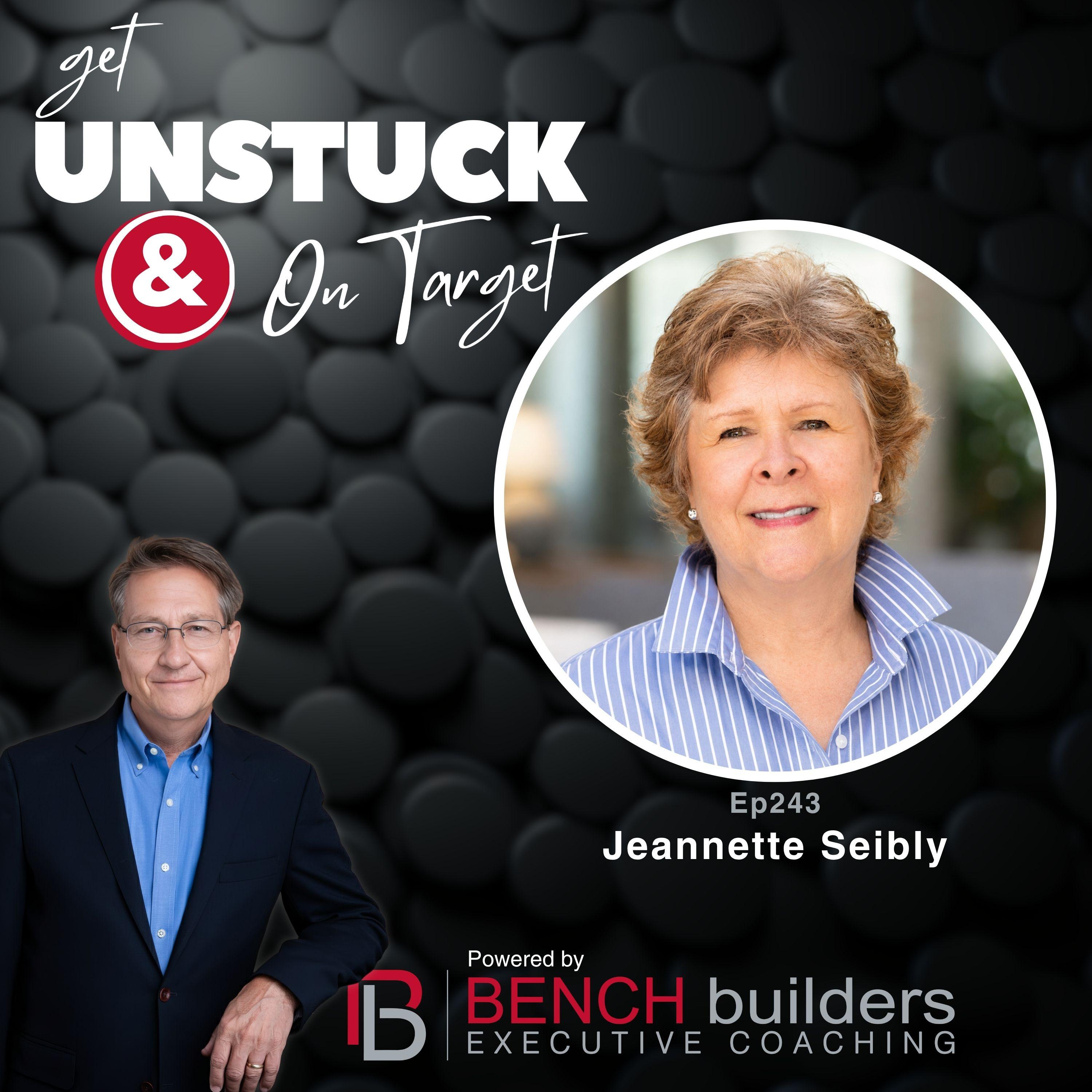
Ep243 Jeannette Seibly—How Senior Leaders Overcome Fear, Stop Stalling, and Build the Legacy They Actually Want
Schedule a Game Plan Intro Call Here
This 15-minute call is a chance for us to connect briefly and see if a full Game Plan Session is the right next step. No prep required — just bring your goals or questions, and we’ll explore whether a deeper dive makes sense.
______________________________
Ever notice how the leaders who seem the most decisive can freeze the moment it's time to actually commit?
In this episode of Get Unstuck & On Target, host Mike O'Neill sits down with Jeannette Seibly, known as the leadership results coach, to unpack why so many senior leaders end up sitting on the fence and what it costs them when they stay there. Jeannette, who has spent decades coaching executives through hiring, promotion, and succession decisions, walks through what she calls the Remy effect (named after her fearless-until-the-door-opens cat) and why fear, not indecision, is really driving the delay.
Mike and Jeannette dig into the job fit triangle, why relying on the interview alone to hire or promote someone can cost a company millions, and how validated assessments like the PXT Select help leaders get real about who they and their people actually are. They also cover how to tell a genuine strategic move from a shiny object and what it takes for a leader who has been stuck for months or years to finally get off the fence.
Three key topics to look out for:
- Why the Remy effect explains why confident leaders freeze when it's time to commit
- How relying only on the interview to hire or promote costs companies millions
- What it actually takes to get off the fence when you've been stuck for months, or years
Jeannette Seibly 0:00
A lot of times, our goals, our dreams are predicated on what we think will make us look good, or what our family expects of us, as opposed to looking within and saying, and using this deliberately, what do I really, really, really want? And it becomes very different.
Mike O'Neill 0:25
Welcome to Get Unstuck and On Target, the weekly podcast that offers senior leaders insights and strategies to not only lead with confidence and vision, but also to achieve groundbreaking results. I'm your host, Mike O'Neill. I coach top-level executives on the power of ethical leadership to forge teams to be as united as they are effective. In each episode, join me for insightful conversations with leaders just like you, providing practical advice to help you get unstuck and propel you and your company forward. Let's get started. My guest today has a 13-pound cat named Remy. Remy will run fearlessly up to anyone, completely fearless. But the moment that they walk through the door, he hides. A lot of leaders operate the same way, all in on the idea, but nowhere to be found when it's time to commit. I've seen it cost organizations millions and costs leaders the legacy that they are working towards. Today's conversation is called "Are You Sitting on the Fence Waiting? If that landed, keep listening. Fence sitting looks like patience; it feels like wisdom, but for senior leaders, it's one of the most expensive habits there is. My guest today is Jeanette Seibly. She's known as the leadership results coach, and you'll soon know why that she's earned that title. I've asked Jeanette to spend some time with us today on the topic of: Are you sitting on the fence waiting? Jeanette, welcome to the podcast.
Jeannette Seibly 2:19
Thank you. It's my pleasure to be here.
Mike O'Neill 2:22
I'm going to jump right in, and that is, let's talk about the fence. Let's talk about why leaders get stuck. And you wrote that fence sitting is a number one problem, and that perfectionism, ego, and judging others are the real culprits. When you see this in senior leaders specifically, what does fence sitting actually look like?
Jeannette Seibly 2:50
It looks like they're overthinking.
Mike O'Neill 2:52
It
Jeannette Seibly 2:53
looks like they're relying on false information. It looks like they kind of sort of, did kind of, sort of some work maybe along the way. Notice all qualifiers in there, and the problem is they didn't get the result they intended because they didn't do complete work. Now, one of the biggest challenges I find with a lot of leaders, I call it the Remy effect. I have a 13-pound ginger-colored cat, and no, he's not fat. He doesn't need to go on a diet. It's just part of his breed, his history, and he loves to meet people. So if he gets out, I call him a door dasher. So he'll run out the door into the hallway, and I don't care if there's a dog out there, or a person out there, he'll run up and say hi and smile. He's fearless, but then if that person or people come into the unit where I live, the apartment, the condo, he hides. And a lot of people are the same way. They're fearless about the idea. Let's go. Let's get it. Something happens, and they become fearful.
Mike O'Neill 4:05
Why? Why do you think leaders do that?
Jeannette Seibly 4:11
They're human. It really is. They're they're human, but there's also the thing called fear. I don't care where you at, where you are at, like if you're, you know, a new leader, a highly experienced leader, but fear does come into play. We're afraid of making a mistake. We're afraid of looking bad. Probably the biggest number one fear in in for people today is feeling humiliated, embarrassed. Sadie did something, and then it turns out they really screwed something up. That's humiliating to a leader, you know that kind of a mistake. So there is just a lot of fear.
Mike O'Neill 4:54
Now I don't want to put words in your mouth, but what I'm hearing you say, particularly we're talking about the Remy effect, is. Is that fear factors into why decisions might be cut off, and I thought was really interesting when you said that that fear applies early in your career, as well as you're an accomplished leader. The consequences are different. So, if that is the case, how do you work with your clients to help them address that fear?
Jeannette Seibly 5:26
Well, the number one thing I do is get real. Let's get real. Like, who are you really? A lot of times, we come up with these ideas that we really, really think we want to do because everybody else is doing it, and we love the another terminology I'll create is called the mimic effect. We love to mimic others, and the problem with that is we all have a lot of self ingenuity. We have a lot of great ideas. Some really aren't going to be cost effective, so you might want to put those aside. Some may not be able to happen right now. It might happen in 10 years, so you might want to put those aside for right now and build towards those. But for the most part, that's what we want to do is like get real.
Mike O'Neill 6:14
How do you help people get real?
Jeannette Seibly 6:17
I focus on who are they naturally? I use an assessment, which I believe you do as well, called the Profile XT Select or PXT Select. It has the world's largest validation study, incredibly accurate, and and meets the Department of Labor guidelines, and that's all the science and legality that I'm going to talk about for right now. But in doing that, people get to look at their thinking style, and a lot of times I find the people I work with is they think really fast. The problem is most people can't keep up with them. In fact, statistically speaking, only 16% of the working population can, and that usually gets them in trouble. They take people on that they shouldn't take on. They get the pink slip the next day. I've worked with people that have gotten fired more than once. I got people that just can't understand why people can't understand what they're talking about, and that's because they're not talking in such a way that other people are getting value. Got
Mike O'Neill 7:30
you. You know, I'm glad you brought that up because I was going to ask you a question. I think you refer to this idea as the job fit triangle, and what we're talking about now is why the wrong people are in the wrong seats, and if I understand correct, 1/3 would be the interview, 1/3 that due diligence, and 1/3 would be that job fit assessment. And at least in my experience, you know, I come out of a corporate HR background. Most companies almost entirely rely on the interview. When companies and leaders do that, rely only on the interview. What's that costing them?
Jeannette Seibly 8:12
Millions. I mean, that's the short answer. You know, it's costing him anywhere from 20 to 50. I mean, there's one study that we found that it costs them 200% of an annual salary. So sometimes people bring on, say, technicians or specialized salespeople, and it takes them one to two years to become fully competent. And the person, a lot of times, they'll bring in 50. By the time they get done, they might have five left, and they think, "Oh, look, I got five left. And it's like, but what about the 40-five that left? You know, you forget that they also talk to your potential customers, or your current customers, or how they feel about your company. It was really important that we get up front. Is let's select five to 10 people to go through the program with the intention of all 10 completing
Mike O'Neill 9:14
it.
Jeannette Seibly 9:14
And the same is like when we promote leaders. I've heard some really really weird stories out there of how people get promoted, and I know you've seen this and experienced it as well. But it's more on the likability factor. So, oh, I really liked him, and I I heard a VP in a bank one time was talking about this guy who got promoted, and his boss just thought he was the cat's meow, but the employees thought he was the the boss from you know where. So, and that's not a positive you know where. So, the point being is that we don't do a full due diligence. We don't ask the right questions. We ask about what's your favorite color. Oh, blue! What does that mean? Because they like blue. How does that fit into the scheme? And we forget to get into what actually do they enjoy doing?
Mike O'Neill 10:11
Yes,
Jeannette Seibly 10:12
because job fit includes their interests, their occupational interests.
Mike O'Neill 10:18
So let me see if I can tie what you've shared so far together, and that is, you you opened us by us talking about you know why do people kind of sit on the fence, and it's your sense that it's fear, and and it manifests itself in a variety of ways. But when I ask how do you overcome that, you said something along the lines of get real with who you are, correct. And now we're bridging. How do you assess that? And we're initially talking about from and in a an interviewing position. When people take an interview, and they they may be thinking only of people outside the company being interviewed to come into the company. I know you work with clients who use that same assessment not only for selection purposes with external candidates, but I think you also work with clients who use that assessment for internal selection choices
Jeannette Seibly 11:14
and coaching and managing. I had a client who went from zero to 4 million in four years, this was years ago, and he was quite proud of the fact of how he went about hiring people. So he did use the PhD select, and then he would take the grid of the seven people that directly reported to him and frame their grid in front of him, so that when something they were in a conversation and something was happening, the person was pushing back, or the person he could just hear they weren't feeling comfortable. He would look at the grid and say, "Oh, that's what happened, and he would then change his approach. I remember one time a woman had called for some coaching because she didn't know whether to fire the guy or what to do with him, and so based on what she hired him to do, he was a great fit. But like a lot of employees, their job lines sort of kind of morph into other areas. Either they're bored, or the other employees expect them to do a little bit more, what have you. And in this case, he was not a good person to be talking directly with customers, so he would misunderstand. He would make promises and not fulfill it. So I said, okay, that's the area you need to train him in and rein him back in, so that he's focused on what he really needs to do, and she goes, "Oh, so you want me to make him great? I said, "Yeah, that would be a great way to really empower your employee to do a good job, because quite frankly, the job you hired him for, he fits real well, and as you've said, he does a really good job. job.
Mike O'Neill 13:02
You know, I use that same tool with my one-on-one coaching, and I find it's very enlightening for a coaching client to learn how they are just naturally wired. And I love what you said. If a person can do that, that comes more naturally. People pick up on that, and if they can be true to who they are, there's some authenticity there. And you made another good point too, and that is how assessments can inform the organization. And I think you made an important distinction: a man who understands how the people they manage are wired, and is willing to adapt to improve the likelihood of of the outcomes, that's a sign of a mature manager. I don't know if we need more validation of this assessment, but what I would like to do is come back to that, and that is, I know that there are folks out there who are using assessments out there, and they think those assessments are validated for hiring, but they're not. Correct. The one we're talking about here is. Can you kind of explain why that's important?
Jeannette Seibly 14:19
It's important because of the validity and reliability. So, are you assessing what you think you are assessing? So, if you're assessing assertiveness, is that who the person really is based on the assessment, or is that how they responded to the questions in the assessment that day? And reliability is if I gave the assessment more than once, would the results come back same or similar? That's the reliability. A good tool also has what's called predictive validity, which means is is the person predicted to do well in this job, and in this case with our. Assessment the PXT select through Wiley they are because we're looking at a thinking style we're looking at a core behavior we're looking at their occupational interests and people might say oh well they got an educational degree that's good and so I've you know worked with attorneys on a scale of one to 10, where some of the attorneys were twos. So it didn't mean they weren't smart. It just means they had to study really hard to get their degree because they learned in a more methodical way.
Mike O'Neill 15:36
Yes.
Jeannette Seibly 15:36
So it really just depends on the job. It depends on what's expected. It depends on the types of decisions, how fast the decisions need to be made. There's a lot of factors that get taken into consideration.
Mike O'Neill 15:49
So you've shared a little bit about why leaders get stuck. You shared that sometimes what we would do is we put people in the wrong seats, and if we could assess that up front, we could do a much better job. The theme of this episode is that fence sitting. Right, that is if you're there. So if you're listening, you're there. Let's talk about that a little bit. What does it take to actually kind of get off the fence? I've read some of your posts where you talk about people chasing shiny objects. They're starting things because they like the idea, but they're not doing the real work required for the results. How does a leader, in your opinion, know the difference between a genuine strategic move and a shiny object?
Jeannette Seibly 16:35
Well, a lot of times, in my experience in working with entrepreneurs, they're idea people-they love their ideas. In fact, I had this woman call me up one time. She was mad because her boss wasn't listening to her ideas anymore. Often do you come up with new ideas? Oh, like every day, maybe a couple times a day. I said, "Well, that could be it. Not everybody's an idea person, and they also don't. Your boss doesn't always know what to do with it either. So, so that's probably the big issue: is how enamored are you with your own ideas? I love to get people together as a team. It could be an ad hoc team. It could be a formal team. Whatever works for the company, the not for profit or what have you, and brainstorm. Like here's the idea. Here's where we want to go. What are some ideas? And really, really, truly brainstorm. That's where a lot of ideas get brought up at that time, and also the workability hopefully gets addressed. Sometimes it does, sometimes it doesn't get caught until later. But that's usually what's missing, because the leader is so enamored with their own idea, or they went to a special event and they got so enamored with the speaker that they wanted to mimic him or her, and the problem with that is it works for them or her, but it may not work for you because you're not the same. You're unique. They're unique, and I think too often people get over overconfident because they've been told they can do it. Well, I've seen a lot of put people put a lot of money into these ideas that aren't theirs and have it fail miserably.
Mike O'Neill 18:35
I like what you described there because I think it fits perfectly with the next question I want to ask, and maybe what I'm looking at is this applies to managers at all levels. But let's think senior managers here for a moment. A senior manager who might even be kind of contemplating things like legacy, and you know this topic of fence sitting is very much aligned with you know being stuck or feeling you're stuck. You wrote that your legacy demands commitment, and commitment requires action. So for those senior leaders who's been sitting on the fence maybe for months or even years, what's at stake if they stay there?
Jeannette Seibly 19:22
Oh. Oh, there is. I even. I mean, I'm just like. There's so many ways to answer that question, but a lot of times, if you're the type of leader who stays stuck, doesn't do what you need to be doing, like moving forward, creating succession plans, things like that. You're going to find your top talent leaving because they want an action leader. They want a boss that they can respect, and that means they're moving forward. They're allowing the employee to learn as they move forward. There's also the cost of losing customers. Because if you're stuck in one area, it's interesting how all of a sudden other areas of your your leadership becomes stuck. Notice how my hands keep moving outward. It's called like a leakage. So we think, oh, because I'm stuck in my job, it won't impact. Yeah, it will impact everything else you do. It'll be subtle. You may not notice it until it's done, and then you're looking back. I know a large family-owned business that the the president, the CEO, is stuck, and he's been stuck there for a long time. And what's happening is because it's family-owned, a lot of people who had been there for a long time with him are leaving, and he's still hanging in there. But what his fear is? What am I going to do? Well, what would you like to do? And he's not able or willing to answer that question and then go for it. Saying that we have is throw your hat over the wall and then go for it. Yeah, and a lot of people saying, yeah, but I'm too tired. I've been at this a long time. Where how much is that going to cost me? Or there may be a medical reason. Sometimes people wait too long and then they ah they are unable. But the sad thing is is they didn't develop a succession plan to support the company and support and allow them to then move forward.
Mike O'Neill 21:29
Then, if you were to begin to kind of recap the things we've been discussing and then add on to that, if we've got a senior leader and they're listening to this episode right now, and they know they've been waiting too long on a decision. It could be a hire, it could be a restructure, it could be a hard conversation. Whatever it is, what is one thing that they can do this week to get off that fence?
Jeannette Seibly 22:00
That's a good question. I remember years ago working with a gentleman who had just turned 70. He was so emotionally attached to having a legacy that included X, Y, and Z, and it just wasn't happening. And so we did the assessment. We talked through other ideas to broaden the X, Y, Z into the full alphabet. And afterwards, he was just gun how. And I just talked with him, and this was 10 years ago because he's about to turn 80. And he goes, "Thank you again, because of that conversation, he saw other opportunities and actually pursued them. And some of the things that he thought he really had to have in order to feel that he could fulfill his own personal legacy, when those opportunities then presented themselves, he said, "No, I'm no longer interested, so that's what happens. Is sometimes things don't move because we're too attached, but also it may not be the right path for us. It may not be who we really are, who what we really want, or and I find this to be really fascinating. I don't care where you're at in an organization. A lot of times, our goals, our dreams are predicated on what we think will make us look good, or what our family expects of us, as opposed to looking within and saying and using this deliberately. What do I really, really, really want? And it becomes very different. And I've worked with a lot of people where they come up with their goal. It's really simple, really easy, and they get okay. Put that aside. What do you really, really, really want? They'll come up with it, and it could be really different. But guess what? They scramble back to the other goal because it's much more comfortable.
Mike O'Neill 24:02
Yes, you know you mentioned really, really, really. I can almost envision when you're working with your clients, the first question might be, "What do you really want? And you get an answer. Correct. And you might ask, "No, what do you really, really want? And you get maybe a different answer. And if you come back the third time, it may take that many times. What do you really, really, really want in which that surfaces? It's got to be gratifying when you help them identify something that has been buried that long.
Jeannette Seibly 24:41
It is. It's like awakening. It is just. It's so cool. But where I sometimes get a little sad is because they scramble back because to their comfort zone. Because anytime you're making a change or any time you're going outside that comfort zone, fear. Raises its head, say, "Hey, don't forget me. And the problem is, is fear is always there. It's here right now. Hi. The thing is, we don't have a good relationship with fear, and we use it like an all-knowing kind of-I don't even know how to describe it-but an all-knowingness that is not correct. It's just there because we walked outside our comfort zone, or what we know, or what we've always
Mike O'Neill 25:30
done. Yeah, I'm actually glad you brought this up because you know my question was: is what could they start doing today? Well, the real world is they may do that, and something happens. And when something happens, what do we all do? We revert back to what we know, and I think what I'm understanding you to be saying is this is awareness and its intentionality, and what I'm hearing you describe is, and it won't happen the first try, but if there is a commitment to stick with it, that they can focus on being true to who they are, realize they're learning new behaviors, they're going to have good days and not so good days. And I think what I'm hearing you say is what I kind of expected in this conversation, and that is, you're direct, you're practical. It's kind of exactly the kinds of straight talk that leaders need to hear. If folks want to learn more, if they want to connect with you and learn more about your work, what's the best way for them to do that, Janette?
Jeannette Seibly 26:43
I would suggest they go to my LinkedIn profile. I'll spell my name for them because just as are really good, they'll misspell it. So it's J E A N N E T T E. That's the first name. The last name is Cybway. It's spelled S is in Sam, E I B is in boy L Y, and go to my LinkedIn. Or if they want to have a, and you can still do from there. Go to have to request a conversation with me, or they can just contact my website. It says Sybco. That's S is in Sam, E I B is in Boy, C is in Cat o.com backslash contact.
Mike O'Neill 27:29
Got you. Thank you. Now we're going to have that in the show notes as well. So if you're out and about, just go to the show notes and all that will be found there. Jeanette, thank you. Your insights have been most most helpful. Let me just offer this as we kind of close. Is something that Jeanette has said today hit a nerve? A hire you've been avoiding, a leader who you've been hoping would figure it all out, or maybe a seat on your team that just isn't right. That's the fence that she's talking about. Again, her links to reach out to her are in the show notes. And if this conversation reminded you of a senior leader in your world, someone making high-stakes decisions without a trusted advisor in their corner, that's exactly who I work with. I coach a few senior leaders one conversation at a time, referrals only. If someone comes to mind, the link to reach me is in the show notes as well. So, Jeanette, thank you for sharing your passion, your expertise, and I want to thank our listeners for doing the real work that leadership requires. And I hope this has helped you get unstuck and on target. Thank you for joining us for this episode of Get Unstuck and On Target. I hope you've gained insights to help you lead with confidence and drive your organization forward. Remember, at Bench Builders, we're committed to your success, your leadership excellence and your strategic growth. If you've enjoyed our conversation today, please leave a review, rate, and subscribe to keep up with our latest episodes. This show really grows when listeners like you share it with others. Who do you know who needs to hear what we talked about today? Until next time, I encourage you to stay focused on the target and continue to break new ground on your leadership path. This show is powered by Media Leads. To get your next great podcast produced, go to medialeadsco.com.

Talent Advisor / Leadership Results Coach / Business Author
Jeannette Seibly is a Leadership Results Coach, Talent Advisor, and Business Author with 33 years of experience activating greatness in leaders and companies. She delivers practical coaching and solutions that elevate performance today, build legacies that stand the test of time, and support people in empowering themselves to lead with clarity and impact.


