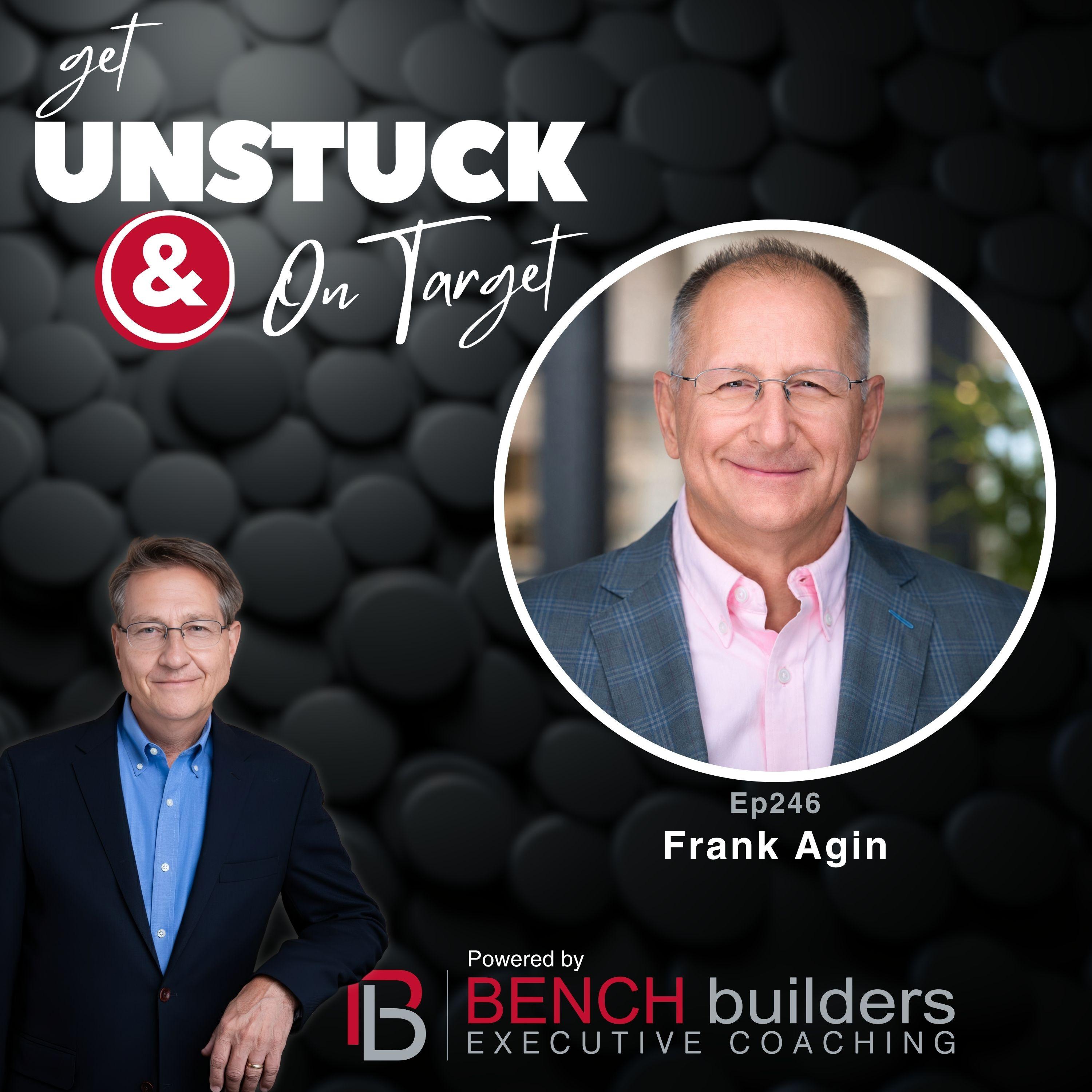
Ep246 Frank Agin—Network Inside the Building and Turn Colleagues Into Advocates
Schedule a Game Plan Intro Call Here
This 15-minute call is a chance for us to connect briefly and see if a full Game Plan Session is the right next step. No prep required — just bring your goals or questions, and we’ll explore whether a deeper dive makes sense.
______________________________
Do you already think you're networked just because you sit in the same meetings with the same people every week?
In this episode of Get Unstuck & On Target, host Mike O'Neill sits down with Frank Agin, president of AmSpirit Business Connections and host of the Networking Rx podcast, who has spent nearly three decades helping entrepreneurs and professionals turn relationships into referrals.
Frank points that same expertise somewhere he rarely talks about: inside the four walls of a company. He and Mike dig into why relationships alone don't produce referrals, what it actually takes to help the people around you look good without losing yourself in the process, and why anthropologist Margaret Mead's discovery of a healed femur explains the human wiring behind trust and loyalty.
Frank also shares how a simple habit, what he calls his Giving Journal, keeps him in the practice of noticing chances to help colleagues without keeping score.
Three key topics to look out for:
- Why "it's not who you know, it's what you do with those relationships" is the real lesson behind networking inside your own company
- The healed femur story Margaret Mead used to explain the first sign of human civilization and what it reveals about who earns trust and who gets left behind
- How to start small, give without expecting anything in return, and let reciprocity work on its own timeline instead of chasing an instant payback
Frank Agin 0:00
The saying is, it's not what you know; it's who you know. But it's not even who you know; it's what you do with those relationships. And I think that's the misnomer with respect to networking inside the walls of a business. These things are touchy-feely. I get it, but that's how we're hardwired. It's not as simple as arithmetic, you know, where the equations are always the same, but it's there. You know, you need to just kind of trust it.
Mike O'Neill 0:27
Welcome to Get Unstuck and On Target, the weekly podcast that offers senior leaders insights and strategies to not only lead with confidence and vision, but also to achieve groundbreaking results. I'm your host, Mike O'Neill. I coach top-level executives on the power of ethical leadership to forge teams to be as united as they are effective. In each episode, join me for insightful conversations with leaders just like you, providing practical advice to help you get unstuck and propel you and your company forward. Let's get started. Most leaders think that their network lives outside the building-referral partners, conference contacts, LinkedIn connections-but what about the network already sitting inside your own walls. Today, I'm talking with Frank Agen, a man who spent nearly 30 years teaching that referrals go to the person that you'd stake your own reputation on, not just the person you've met. We're turning that idea inward. Frank calls it the network inside the building, and why it matters just as much as the one outside it. If you've ever assumed that you're networked just because you sit in the same meetings every week, this one's for you. My guest today is Frank Agan. He's the president of MS Spirit Business Connections, and he's the host of the Networking RX podcast. He has spent nearly three decades helping entrepreneurs and professionals turn relationships into referrals. He has written multiple books, but one of the book title catches my attention, and that is Foundational Networking and the three reasons you don't get referrals. Frank's whole world is built on one idea: people refer business to the person that they stake their own reputation on, not just the person that they've met. But today we're taking that same idea and we're going to point it somewhere that he usually doesn't talk about, and that is the key parts of understanding of inside the four walls of a company. People normally think of outside the company. So my working title for this episode is "The Network Inside the Building: Why It Matters as Much as the One Outside. Welcome, Frank.
Frank Agin 3:03
Thanks for having me.
Mike O'Neill 3:06
Listeners are going to find how easy it is to listen to Frank. Frank, you are a podcast host. Your podcast. How many episodes are you up to?
Frank Agin 3:16
At this point, I just recorded 950 199, 151 episodes. Yeah,
Mike O'Neill 3:22
so you can tell automatically. Frank is not only good at talking about what he does; he surrounds himself with with people, and I think you're going to find that that's exactly what we're going to talk about. Let's start with the gap, and that is most people probably already in a company. They think they're already network because they sit in the meetings with the same folks every week. But what's wrong with that assumption? Well, I mean, those are certainly relationships. I mean, let me-I guess-let me back up and give you my backstory. I live in Columbus, Ohio. I came here to go to law school. I have a law degree. Have an
Frank Agin 4:00
MBA. Started my career in public accounting. I was a tax consultant and did that for six and a half years before I left to be an attorney in private practice and ultimately an entrepreneur consulting with small businesses around the country. I tell people if I had to do it all over again, my corporate experience would have been vastly different. I went to work. I worked hard. I certainly knew the people in there. I had relationships, but I didn't use the relationships in the way in an effective way. And I think that's part of the problem. Is people think, okay, well, I know these people, and it's like, okay, but what am I doing with the relationships? I kind of looked at people as, okay, I'm trying to get mine. I'm trying to get ahead. It's me versus it's me versus Tom. It's me versus this. It's me trying to get these resources that other people don't have. And if I had to do it all over again, I would step back and say, "Okay, yeah, I need to move ahead, but the best way to move ahead is to help the people around me move ahead. Yeah, you know, help them, help my boss look good, help my boss's boss look good, help the person in the cubicle to the left and right of me look good, and realize that even if that cost me my position, somebody will want me because you kind of have this. You have you start having this reputation of serving other people, and so it's not just it's not what we know. It's not the saying is it's not it's not what you know. It's who you know, but it's not even who you know. It's what you do with those relationships, and I think that's the misnomer with respect to networking inside the walls of a business. Yeah, I'm glad you kind of clarified that because I think you framed that up a little bit differently than many people have been thinking, and that is
Mike O'Neill 6:00
when you were talking about networking inside the company, that could feel to folks watching or listening, it could feel fake, or maybe even you know inside politics. Whereas doing it outside the building might feel might more normal. How how does how do you recommend that one finds that balance on helping others achieve what they're trying to do. Those around that you work with every day.
Frank Agin 6:29
Well, in my mind, you know the company's working for a greater good, right? And so a lot of us get in these silos, right? There's the HR silo, and I'm just overgeneralizing. There's the HR silo. There's the accounting silo. There's the finance silo, which you think would be accounting, but it's not. You know, there's these. There's the store planning or the the product people, and it you know depends upon where's manufacturing, whatever, and all these different silos, and they all need to work well. If things aren't selling, there's nothing to account for. Yeah, you know, if there's nothing to account for, then there's really no need for HR because we can't hire people. You know, finance loses its meaning as well. So, one of the things I talked when I talk, this is not my first conversation on this particular topic. I'll say, you know, stop and think about what's going on in, you know, whatever part of the the company, and having a conversation with them and figuring out what are the challenges that they have. I don't know what HR does. It's meaningless. Well, I'm going to tell you right now, it's not meaningless because there's a lot of really smart people out there who've started companies and they have an HR department. Why? Because there's a lot of regulations, and you just don't know what they do. So take the time to understand what they do, and take the time to get them to understand what you're about, because then that creates opportunities to to help them, right? So maybe you're talking to somebody who's in HR in another company, and they talk about something that they're doing, and you can go to your HR person and say, you know, I had a I had a beer with a guy, and they're they're doing this at X Y Z company, and it's just apparently the software that's out there, or something that you know they might not be aware of, or somebody might say, you know, we're you know we're really struggling to find people in HR. It's like, well, I I know somebody, you know, they're not looking, but they have some people in their company that they're thinking about letting go because business is slow, and we could take advantage of those people, so I think there's lots of different ways we can we can we can help each other within within a company, and it's you know just understanding what other people do.
Mike O'Neill 8:53
Well, let's draw that down even further. We're talking right now about referrals, networking within the organization, but you've been doing this for a long time, decades. You're studying why people refer business to one person and not another. Can you elaborate? Have you just found that there are reasons why some get more of these opportunities than others?
Frank Agin 9:21
Well, it comes down to it's all human nature. People do business with those that they know, they like, and they trust. I mean, it's not just business, Mike. It it really gets down into human nature. One of the stories I I talk I I really I'm really into the science of networking and understanding the sociology and the psychology behind why people are doing these things. There was a a story out there. It's not a story. It's true. There was a famous anthropologist. Her name's Margaret Mead, and Margaret Mead was teaching a course. And one of the students asked, "What was the first sign?" Of human civilization, as she was gathering her thoughts, people are thinking, "Okay, clay pots, fire, weapons-you know, whatever language. And her answer was a healed femur, and she went on to explain that in the animal world, a broken femur, which is the bone that connects the knee to the hip, is a death sentence. Most animals have that. It's a death sense because they can't protect themselves. They can't forage. They're just going to die a slow, agonizing starvation death, or they're going to be taken over quickly by a predator. But in the human world, when we found human remains, when somebody clearly had a broken femur and clearly it healed. We realized there was something different, and this was back when we were hunter gatherers, right? So we were very nomadic, always on the move. We realized that somebody stayed behind to care for that person, and without modern medical care, it takes about six to eight weeks for that bone to heal. So somebody stayed behind for six to eight weeks, and so if you stop and think about it, if there's a group of four people, and somebody breaks their femur, and the other three say, "You know what? We're sorry, sorry, Mike, we're on our way. Well, Mike's going to die. Well, the other three are positioned not as strongly as they were with four, and so chances are they will die. But if you go to another group of four people and Mike breaks his femur, and those other three people say, "You know what? We're not going. We're going to care for Mike. We're going to feed Mike. We're going to keep Mike warm. We're going to protect him until he's ready. Six to eight weeks later, that group moves forward with four people, so it's much stronger than three. But they're going to move forward with a guy named Mike who knows that everybody cared for him, and he's gonna he's gonna return that favor because it's really human nature. So the one group where they moved on and became three, which became two, became one, which became none. That gene pool died, whereas the gene pool of the people who cared about each other moved on. So I tell people that we are really looking for people who are metaphorically speaking, we're looking for people who are willing to stay behind when we break our femur. We are looking for people who are willing to contribute to the greater good. We're looking for people that we can trust, and that's that's ingrained in every one of us. So when we're you know when we're looking to when we're looking to hire on people, we're looking to hire on that person who's going to be there when we need them to be there. It might not be as dire as a broken femur, but it's you know what we might be losing our biggest client. It's all hands on deck till two in the morning. Are you are you going to be here? You need to know that. When one of the one of the stories I have from my six years in public accounting, I remember there were there were a lot of different players in there. You really didn't have one particular boss. You had lots of people you you reported to, and there were a lot that just didn't impress me at all. But there was one guy I I've got an assignment from another partner to do something, and the other partner said, "You know, I got to go. Johnny's got a ball game. I'm out of here. Leaving at 5o'clock, and I'm going to be languishing there till 9o'clock at night. And I've got questions, and you know, I don't really have a lot of direction.
Frank Agin 13:15
But this other partner happened to be there, and he kind of saw what was happening. He just came to me, he said, "You know what? I'm not leaving until you leave. If you have questions, come to me. I don't know if I exactly have the answer. We'll figure it out. But I'm not leaving till you leave. Wow, I would walk through the fires of hell for that guy. You know, and we never really worked with one another, but I just knew what he was about, and that's what we're looking for. And that's you know those are the types of relationships we need to try and have. And you can say, well, yeah, I need more people like that in my life. How about being that person? Yeah, that you can control that. You can't control the people around you, but you can control saying, you know what, you got to be here Saturday. I'm coming in. I'm going to help you, and you know, you'll rather than being here all day Saturday between the two of us, we'll get out at noon. We'll be able to go see the ball game or whatever. People remember those things.
Mike O'Neill 14:15
They do, and if they're leaning in and are saying, you know, I want to be more like that partner who said, "I'm not leaving till you leave. For those watching or listening right now, let's say they say, "You know, I want to be better at that. That doesn't really come natural to me. What might be, in your experience, ways that that can become more natural? What might be a good first step?
Frank Agin 14:39
Obviously, that's a big thing, right? Hey, I'm not leaving till you leave, and and certainly depends. You know, if you've got a if you've got a family, that's that that can be a difficult thing. What I always tell people is start small.
Mike O'Neill 14:50
Yeah,
Frank Agin 14:50
you know, look for the small things where you can where you can make a difference in people. Having a conversation. With the administrative staff, just or just anybody. How was your weekend? And really, really, not a passing. Hey, how's how you doing? But you know, your son plays volleyball, right? Yeah. How'd the weekend go? And you know, social media is great because you can kind of follow people. And there's a woman I know locally, and her daughter was playing softball, and it was iffy whether her daughter was going to play her senior year or not. And so she finally ended up playing. I know the mom was so excited about this, but just every time I saw her, it's like, "How's your daughter doing? You know, it looks like they're still in the tournament. Wow, this is great. You know, they and they they end up being state runner-ups. But you know, I could just every time I asked that question and was truly interested, you could just see her light up, and so we can certainly do those sorts of things within within the business. And what I find is, well, one of the books I wrote, and it's it's actually free. I give it away for free. It's on it's it's on our website. It's called the Giving Journal. And Mike, years ago, somebody said to me, "Oh, I'm very generous. Blah blah blah blah blah. And I looked at them and I thought to myself, "They are the most selfish person in the world. How can they say they're a giver? How can they say they're generous? And then I thought to myself, "They're delusional. Maybe I'm delusional too. So what I started to do is, I took a notebook and I started keeping track of when I did things for people. Served on a board, took time to look at somebody's resume or give somebody advice, made an introduction, just the little things, and I didn't do it to keep score. I just did it to, I did it just to test myself. And what I found is, is that journal called to me.
Mike O'Neill 16:43
In what way?
Frank Agin 16:45
It would be on my desk, and I would be like, "Oh my God, I haven't done anything in five days.
Mike O'Neill 16:49
Ah,
Frank Agin 16:50
you know, I need to make sure I have something there every day. Heck, why not twice a day? Why not three times a day? And so it made me more in tune to the opportunities around me to help other people, to just be encouraging. You know, somebody would say, "Yeah, we're struggling with this, and me reaching out to somebody else and saying, "You know, I got somebody they're kind of struggling with this. What do you think? Oh, there's a great article. There's a study that was done. Taking that study and giving it to them, like, "Here, listen, here's something you can read. Maybe this will help you. Or here, I've got a friend that you can talk to, and they might be able to help you. It helped me become more in tune with the
Mike O'Neill 17:30
to look for things to help other people. And none of them were huge. And and most of them were not. Hey, I gave 50 bucks to whatever society, or it wasn't. It was all about contributing time, talent, social capital, making introductions, things like that. When you mentioned keeping a journal, and you pointed out not to keep score, but what it did for you, and I'm sure others, is it serves as a reminder of initiating, taking that first step. You also encourage us start small. Yeah, but let's say that what you're doing is you start small and you reached out and something came up, and it warrants circling back. Do you have practical ways to help people remember to do just that.
Frank Agin 18:24
Well, certainly putting reminders. You know, we we we live in a wonderful time. You know, when I started out in in my entrepreneurial journey, I had a computer, but we didn't. You didn't have all the apps. You didn't have all. You know, you had a spreadsheet. Maybe when I started my career there as a tax consultant, there was one computer on the whole floor. I mean, the the administrative people all had word processors and that, but there was one computer, and I needed the computer for an hour. So we were fighting over one computer. So we live in a great time where we can have these sorts of reminders. We can put them on our phone and kind of put systems in place, so there are there are things out there that you know we can we can remind ourselves, and it's it's really kind of a simple habit. Just just just commit to okay, I'm gonna I'm gonna make this a habit. I'm not saying everything, and you know maybe it's just doing something once a week for somebody. If you're starting out right now and haven't done anything within your company, to say, okay, you know what, this week I'm going to do something nice for somebody. I'm not exactly sure what, but I'm going to make a point before the week is over. I'm going to do something nice for somebody, and and do it. And in time, it becomes easier, right? You start to look for things, you know, and then all of a sudden, it's like, well, why am I waiting? I've already done one nice thing. Why am I waiting for next week? It's right here, you know. This person's having a tough day, you know. Maybe I can help them. You know, you seem to be really busy. I'm going to get lunch. What can I get? You, you know, just little things like that, and people people remember those things. They they not only remember Mike, they tell other people about them. You know, as I'm telling the story about this one partner that probably doesn't remember me at this point because so many people have come and gone gone from the firm. I remember him, and I remember that gesture, and I told people the next day, "Yeah, I was here late, but so was he. That that meant so much to me. Yes. So
Mike O'Neill 20:30
let me be a little bit pragmatic here for a moment. You've encouraged start small, but be intentional, be real. If what you did for them needs follow up. Do it. Put it down somewhere to remind you to do it. But you're not suggesting that this is being done in a transactional way. What I'm hearing you describe is that when you start doing that, it becomes easier as the habit progresses, but let's talk practical. For those who do those kinds of things, that they're looking out for others. In what ways does it come back to to them?
Frank Agin 21:15
Give without expectation. Do things and don't expect anything in return. Things have a way of circling back, and a lot of times it doesn't come from the person that you have done something for. Interesting, good point. You know, it it and and it might be this guy hypothetically this this this partner's you know stays behind. The partner reports to somebody, word gets out that you know this, you know that he's done this for me. Other people talk about it. It gets to his boss, and it's like you know what, you did some great things for for morale here. You know, here's an extra bonus, or here's a client, right, or here's whatever. I know you can handle this. So the the things do come back to us. You just have to trust. You have to trust karma. Trust how these things work. But the other thing I'll say with respect to that is, is that we're we again back to the femur story. We are looking for people who are willing to stay behind for us. And when we find those people, we need to invest in them too. So this partner did this for me, and I don't know that I ever really had an opportunity to do something, but I would have, right? Because you know, whatever it might be, I would have because I'm looking for a way to give back to them and and people. I I help lots of people because I love to help people, and I will have people circle back and say, you know what, I I need to find a way to help you. And my response to that is, that's great. I real no pressure. That's great. I appreciate that thought. It's great to know that's out in the universe. But in their their minds are working on things, and I see a lot of people where it just comes out of the blue. Where it's, you know, hey, so and so said I need to talk to you. So and so recommended this, and you can't measure these things in hours, days, years, or decades. It's just it it could be a you know it it could be a long time. Where and I've heard stories about this certainly in the entrepreneurial world, where somebody does something, and then 20 years later happens to run into somebody again, and they're like, "Yeah, you know, you you helped me out all those years ago. I, you know, I I I can use your help now. So it it does work.
Mike O'Neill 23:36
You know, as I'm thinking about you, you stress don't do these things with the expectation of you know reciprocity, if you would, you know I I work with leaders, and what I'm thinking is let's say that scenario unfolds and that person gets promoted, and they get promoted into a role that they're leading others. If they continue to do that. The people who they lead are watching that. Yeah, and if that happens, all of a sudden your action begins to cascade, and then because you're leading a group, what ends up happening within the organization is your group develops a reputation of hey they the group have our backs yeah and when that happens what that can very much mean is if you're in a role that oftentimes gets pushback that can soften that because they see oh they're just doing their job. So I'm, I'm hearing you. I guess what I would throw out to you is, for for those who are saying, you know, this is a little bit too touchy feely. What I'm trying to to speak to is there is advantage in doing this. It does have a ripple effect. Yeah, and in. The ripple effect that at the end it's going to come back in a positive way, and I think you made an interesting point that I don't want us to miss. The way it comes back may not be the person that you helped, right? It may be someone who they told, or they helped someone, and someone was attributed back to you. This is this is very interesting. Margaret Mee was a smart woman, was she not?
Frank Agin 25:27
Yeah. Oh, absolutely. Yeah. I mean, it's you know when it was somebody on my podcast who told me that story, and I I felt chills go up and down my spine because it's like oh my gosh, that's for me that's the holy grail that explains why we're the way we are, and you mentioned touchy feely. Well, these things are touchy feely. I get it, but that's how we're hardwired. You know, we fall in love with our spouses. That's touchy feely. Yes, but it's pre. You know, it's programmed. The things we do and why we care for people, and that's all, you know, it's all, it's all pre-programmed. It's not as simple as arithmetic or chemistry or something like that. That's you know where the the equations are always the same, but it's there, and you just need to, you know, you need to just kind of trust it.
Mike O'Neill 26:25
You've been doing this for now three decades. You've seen so much happen in that time frame. I'm for those who are looking, you know, they're looking at a bookshelf of books that you have written. You have a gift for storytelling. Where do you see things going from a networking standpoint, both internally and externally? I don't see it changing. People have asked the question. This goes back a few years now. What do you think LinkedIn is going to do to networking?
Frank Agin 27:00
My answer is nothing. Yeah, the telegraph didn't change it. The phone didn't change it. Email didn't change it. LinkedIn is a tool. LinkedIn is a tool. Zoom is a tool that allows us to connect with one another over hundreds of miles. But we still need to develop no like and trust, and I know people all around the world. People I have never met. I've got a good friend in Estonia. We have lots of great conversations. I know her. I like her. I trust her. I may never meet her face to face. Zoom has allowed us to develop the relationship, but the relationship is very genuine, as if we lived in the same little town in Ohio or Estonia, so you know where is it going? It's really not going anywhere. It's you know we still you know we still have to you know we still have to have those feelings towards people you know that hey we trust this person they they're going to help me when I need help I'm going to help them when they need help and and that's what I love about what I do is because it doesn't change, right? It's a you know it doesn't change. It's you know you just you get more refined with respect to it, and so it makes it it makes it simple. You interview me 10 years from now, I'll say yeah, just find a way to help other people, and trust it'll come back to you, and it will.
Mike O'Neill 28:22
I was trying to think how did I get introduced to you, and I got introduced to you by a prior podcast guest, and she said, "Mike, you need to you need to know Frank. He probably would also be a great podcast guest if he's willing to do so. He's very busy with his own. You and I had that conversation, and it was well into the conversation that I even brought up the podcast. For those who don't know, Frank, we hit the record button after about a 20-minute conversation, not about the mechanics of the podcast, but Frank was pouring into me before we even officially began recording this episode, so if you're questioning, is Frank the kind of person who who walks the talk without a doubt? Frank, you mentioned that you have had lots of guests on your podcast. I have learned greatly from my my guests. You are a perfect example of the the people I get to meet with, I get to learn from. For those who want to know more about you, or reach out to you, or to maybe begin that relationship journey with you, what's the best way for them to reach you? I have a website. Well, I I'll say this: I'll meet people where they are, some people like to text, some people like to email, some people like to LinkedIn message. I'm an email sort of person, but I'll meet people wherever they, you know, whatever works. I talked to a couple of my franchisees yesterday, and they're like, "We like to talk. We don't like to text. We don't like to email. We like to talk. Okay. I'll be flexible. I'll meet you where you're at with certain parameters. You can't. You can email me 24 hours a day. You can't call me 24 hours a day. But I have a website out there, frankAgen.com, and shows all the books I've written. It talks about the things I've done in a positive way because I put it together. But it has my contact information. It has my email and different ways of getting a hold of me. So whatever works for them. So excellent, Frank. Thank you so much. Thank you for our listeners. If something that Frank has said today, if it landed that the relationships that are already sitting right in front of you, they might matter more than the ones that you're chasing, even outside the building. Take Frank up on his offer. The links to be able to reach out to him, to include email, phone number, website, will be in the show notes. And if you like conversations and want to have more opportunities to hear conversations like this we've had with Frank. Let me invite you subscribe to Get Unstuck and On Target on YouTube, Apple, Spotify, wherever you listen. And as you've been listening, if someone came to mind, a senior leader maybe caring too much without a trusted advisor in their corner, I'd love an introduction. I keep a small number of coaching relationships, and I take new clients by introduction only. So, if you'd like to reach out, the link to do so is in the show notes as well. So, I want to thank you for joining us, and I hope that this episode has helped you get unstuck and on target. Thank you for joining us for this episode of Get Unstuck and On Target. I hope you've gained insights to help you lead with confidence and drive your organization forward. Remember, at Bench Builders, we're committed to your success, your leadership excellence, and your strategic growth. If you've enjoyed our conversation today? Please leave a review, rate, and subscribe to keep up with our latest episodes. This show really grows when listeners like you share it with others. Who do you know who needs to hear what we talked about today? Until next time, I encourage you to stay focused on the target and continue to break new ground on your leadership path. This show is powered by Media Leads. To get your next great podcast produced, go to medialeadsco.com.

Founder, President, Author
Frank Agin is president of AmSpirit Business Connections, which empowers entrepreneurs, sales representatives, and professionals to become successful and gain more referrals through networking.
He also shares information and insights on professional relationships, business networking and best practices for generating referrals on his Networking Rx podcast and through various professional programs.
Finally, Frank is the author of several books, including Foundational Networking: Creating Know, Like & Trust For A Lifetime of Extraordinary Success and The Three Reasons You Don’t Get Referrals. See all his books and programs at frankagin.com.


