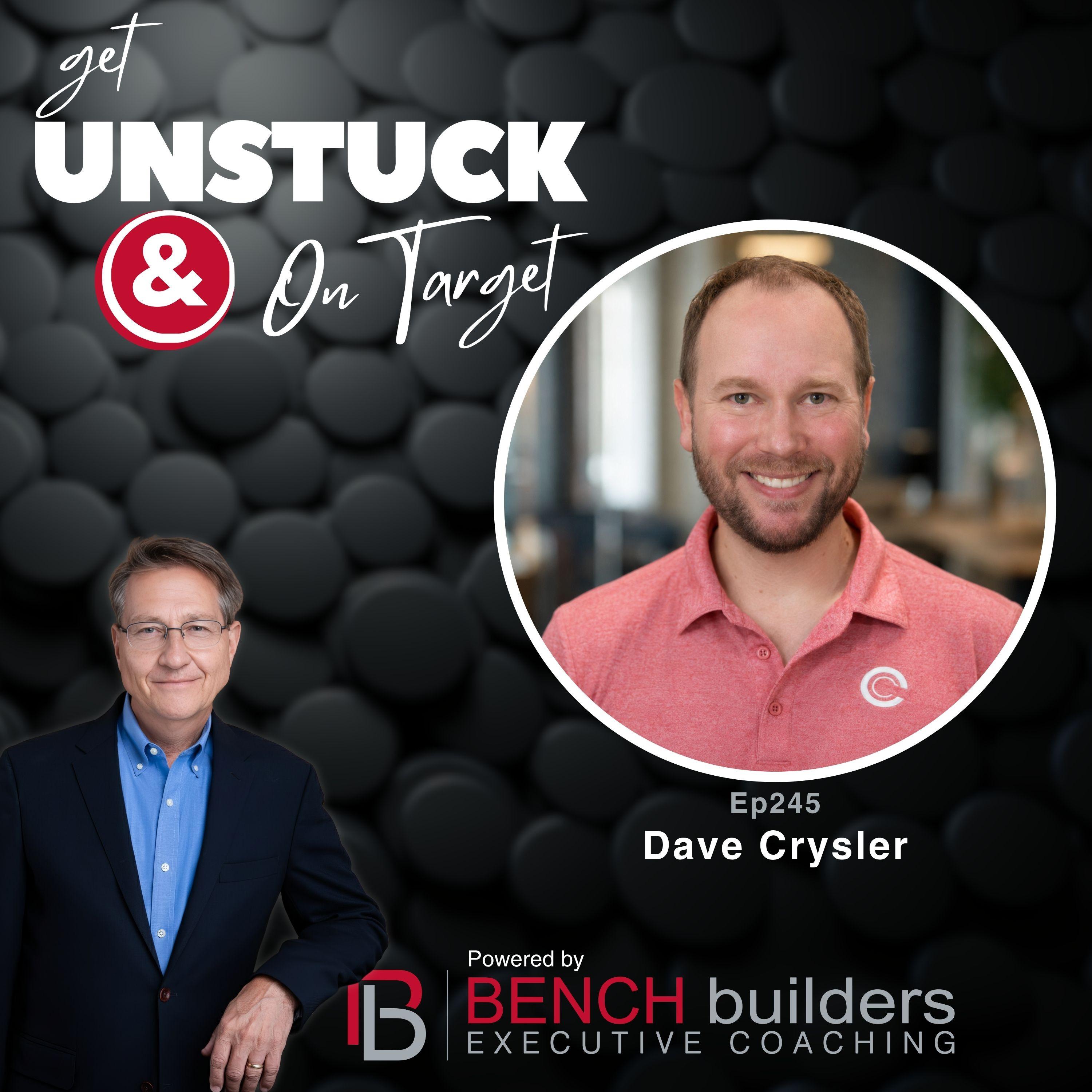
Ep245 Dave Crysler—Stop Buying Tools to Fix a System Problem
Schedule a Game Plan Intro Call Here
This 15-minute call is a chance for us to connect briefly and see if a full Game Plan Session is the right next step. No prep required — just bring your goals or questions, and we’ll explore whether a deeper dive makes sense.
______________________________
Is your business actually growing, or is it just getting busier? There's a difference.
In this episode of Get Unstuck & On Target, host Mike O'Neill sits down with Dave Crysler, principal operations consultant at the Crysler Club and host of the Everyday Business Problems podcast. For more than 25 years, Dave has helped small- to mid-market manufacturers fix the systems quietly eroding their margin, slowing their throughput, and stalling their growth. His clients typically see 5 to 10% margin improvement without adding headcount or buying new tools.
Dave and Mike get into what happens when growth comes through acquisition and two companies' systems have to coexist or collapse into one, why business owners keep buying new technology to solve problems that were never about technology, and what it actually looks like when a business is stuck: the same problem resurfacing no matter what you throw at it. Dave walks through two client stories, a custom manufacturer that cut its lead time from 4 to 6 weeks down to 4 to 6 days, and a product quality issue that had quietly been going on for almost a decade, and explains the free cost of chaos calculator he built so leaders can put a real dollar figure on what's not working.
Three key topics to look out for:
- Why most operational problems are system problems, not people problems, and what a system actually includes: planning, people, process, and technology
- The real story behind a business owner who thought a new ERP would fix his team's follow-up problem, and what was actually broken
- How to quantify the cost of chaos in your own business before you try to fix it
Dave Crysler 0:00
There's no such thing as over communicating. You know, there's no such thing as over transparency. Sometimes we're so close to the things that we've been thinking about that we forget to bring other people into the conversation.
Mike O'Neill 0:17
Welcome to Get Unstuck and On Target, the weekly podcast that offers senior leaders insights and strategies to not only lead with confidence and vision, but also to achieve groundbreaking results. I'm your host, Mike O'Neill. I coach top-level executives on the power of ethical leadership to forge teams to be as united as they are effective. In each episode, join me for insightful conversations with leaders just like you, providing practical advice to help you get unstuck and propel you and your company forward. Let's get started. Here's a question worth sitting with: Is your business actually growing, or is it just getting busier? There's a difference. Dave Chrysler has spent 25 years helping small to mid-market manufacturers answer that question honestly. He calls it the cost of chaos-the real dollar figure hiding behind the problems that you keep trying to fix. If something in your operation keeps coming back, no matter what you've tried, Dave's the kind of person that you need to hear. My guest today is Dave Chrysler. He's the principal operations consultant at the Chrysler Club and hosts the Everyday Business Problems podcast. For more than 25 years, he's been helping small to mid-market businesses fix the systems that are quietly eroding their margin, slowing their throughput, and stalling their growth. His premise: most operational problems aren't people problems; they're system problems. His clients typically see five to 10% margin improvement without adding headcount or buying new tools. So, for leaders listening, you can see why I invited Dave on the podcast. Welcome, Dave.
Dave Crysler 2:19
Yeah, thanks so much for having me, Mike. Excited to to get into the conversation with you.
Mike O'Neill 2:24
You know, we've actually have had the opportunity to have not one but multiple conversations before we scheduled this podcast, and so I know a little bit about your history. Let me see if I'm recalling this correctly. You grew up watching your parents build businesses, watch them work really hard. They built them, but sometimes in the process doing that, it might have been something that kind of held them back. Me, you know, how did that shape watching your parents build these businesses? How did that shape how you see operations today?
Dave Crysler 3:00
Yeah, I mean, you know what's interesting about kind of growing up the way that I did, I I just took those things for granted. You know, I I thought everybody you know spent a tremendous amount of hours, you know, like nights and weekends at the shop because that's what we did. You know, we we used to spend kind of all the time I wasn't in school at the shop, and you know, I tell stories about running around, you know, on the production floor, you know, riding the the fork trucks in Big Joe back in the day, and you know, all the things that you don't want OSHA to find out about. But you know, to answer your question, Mike, I mean, honestly, when you're so close into it, you know, it's really difficult to kind of see what is around you, right? So, for me, the the real unlock or kind of genesis was, you know, growing up in that environment and then going to work for a publicly traded company that grew through acquisition, and so you know, they were acquiring those first and second generation family-owned businesses, so that was very familiar to me. And the part that really helped me kind of unpack what some of the the the growth stalling was for even back for my parents was, you know, kind of being surrounded by this systems thought process, right, and starting to to be responsible to pull on these levers that not just allowed us to you know pay back those initial investments, but do what I was ultimately there to do, which was grow that business. And so you know every opportunity I had to kind of go into a business, whether I was physically relocating and you know the person on the ground floor, or kind of as my career progressed, you know, doing that from afar through a mentorship, you know, kind of capacity helping leadership teams that were you know at those facilities that we had recently acquired kind of do the same thing, but you know from a different. Perspective. It was really, you know, those kind of dynamics that allowed me to to ultimately see this gap and to start to build towards something that, to me, was approachable, makes a lot of sense, and and I think that's, you know, there's lots of folks that kind of have have had similar journeys or or you know, kind of are in consulting types of roles, but I think oftentimes you know they're they kind of say high level things you know at what everybody knows you know it's like oh it's a systems problem it's like but what does that really mean like how do we dive down deeper and unpack what that is how did we get to the place that we are today, you know. It's kind of the death by 1000 cuts, where it wasn't just somebody didn't set out to, you know, have stalled growth and and repeating problems, right? But like, you just wake up in that situation. You wake up and you're like, man, boy, we sure have had a lot of turnover these last couple of years. Boy, it's been really difficult to get traction. We feel really busy, but you know it just doesn't seem like we're we're adding dollars to the bottom line, or if we are, it's you know not hitting our cash flow. So it's all of those little things and kind of that you know genesis really throughout my career that allowed me to you know kind of do what I do today, but but really to be able to unpack some of those gaps and start, you know, ultimately working towards figuring out a way to to fill them and fix them, I believe you you work primarily with manufacturers. Is that correct? Yeah. Yep. Okay.
Mike O'Neill 6:36
And what I have a particular interest in is growing manufacturers and what growing pains actually kind of look like? Growing could be organic; it could be through acquisition. When you talk about systems, which is a catch-all term, when a company acquires a company and that other company has its own processes. What do you find is typically the practice? Do they just kind of coexist, or do they try to coalesce to one standard?
Dave Crysler 7:11
Yeah, I think it really depends. You know what? What I say is that it generally acquisitions and growth kind of it either happens by you know default in the sense that you know we've got this idea that we're going to go acquire market share and we're going to do that by purchasing somebody else and you know in some companies that have gone through that cycle they're strategic about it they understand kind of what you know repaying that investment back looks like and then how they plan to ultimately, you know, grow that business, right? And there's two different ways to do it. You kind of let that acquisition operate, you know, somewhat independently, right? Where where you're purchasing it from a strategic perspective, and you value the systems that they have built, right, and you want to support that effort. So that's kind of one way. The other way is, you know, to kind of do what what I would call like a a tuck in, which is going to be more about you know, kind of taking you know the customer base and or the product line and kind of absorbing that. So in that scenario, more than likely you're going to be looking at taking your systems and kind of replicating those in that acquisition. So to me, those are kind of the two different you know ways that I see it get sliced up. And you know I say sometimes it happens by default because some companies that are new in that right they haven't really thought through all of that. So they get in, the deal closes. You know, you show up on Monday, and it's kind of like, oh, boy, we didn't realize that. You know, we now have two ERPs, two WMSs. We have you know two HR standards or systems. We have different cultures. You know, we look at our customer base through a different lens, right? Like one is more relationship based, the other one is more transactional. You know, we have higher, you know, revenue or you know, kind of dollars per order in one business than the other, and now we're kind of being reactive in the sense of, ah, what do we do? You know, how do we kind of play nice? How do we grow? You know, this business now that that we've got kind of multiple arms with. So, yeah, acquisitions can be a a tricky thing, especially in the early days. If if you've never done a transaction, if you've never, you know, put some strategic lens around why are we actually doing this to begin with?
Mike O'Neill 9:54
So, I hate to use a generic example, but let's just talk about an. Acquisition, and there are two approaches of everything, different systems, if you would. Is there a general rule of thumb that you have advised your clients? They're smart enough to bring you in early, hopefully before the decision. But have you found that there are certain things that must come together quickly, and is there a kind of a natural sequencing that seems to have emerged in your experience?
Dave Crysler 10:29
I think so. I mean, to your point, you know, I would say some of the you know some of the best kind of you know current state sprint work that I've done has been you know in anticipation of a deal, right? So, you know, kind of in the due diligence phase, we're doing some deep dive into, you know, not just systems, but kind of the entire, you know, operation to better understand how could we marry these two businesses together, right? What are what are kind of the advantages and disadvantages. What thing should ultimately stand on its own? How does their you know kind of customer base is that complementary? Is it competing? Are we really purchasing ultimately what we think we're purchasing, or are we getting something a bit different? And again, just because of you know how I grew up in in my career, you know, I think I bring a somewhat unique lens to that because I've I've been the person that has showed up on Monday morning after the deal closed and was like, "Whoa, I I'm not sure we realized what we were purchasing here, right? And kind of had to figure out what those you know integration steps look like. How do we bring in you know kind of a a corporate culture in that scenario? It was corporate culture versus you know kind of family owned and and family operated. I think the first few steps, though, to kind of get to the second part of your question, you know, really really come down to visibility, right? So the nice part about where we're at today in terms of technology is that the the kind of interconnectivity, the ability for you know tools to talk to each other, has kind of never been easier, right? So getting some quick visibility on you know financial transactions, you know, AR, AP, kind of where we're at in the sales cycle, you know, followed by like customer relationships, and then I would kind of start to say like operationally, as even though that's my sweet spot, right? Like as the kind of third leg of that pillar, because ultimately, you know the operational side of things can kind of survive. You really need to get visibility from, you know, that financial perspective and kind of customer perspective to understand what's the baseline, how how are things kind of laid out, and then we can start to layer in, you know, the real kind of operational systems. So,
Mike O'Neill 13:02
you know, I appreciate your willingness to say, though you're an operations expert in terms of this pecking order, that might not be first or second. Yeah, you also made reference to the culture. That's the part I find myself kind of leaning in the culture of the the people you've got, the leadership, how you're developing them, etc. It poses another thought, and that is, they bring you in. You've helped with the due diligence. The transition has begun, and there's all these moving parts. How do you advise a client to not lose sight to they still have customers out there that have to be serviced versus getting so focused on the integration.
Dave Crysler 13:50
Yeah, I mean, you know, it really starts with transparency and a lot of communication. Yeah, I shared this with somebody. I I saw somebody make a post the other day on LinkedIn, and you know, one of my my kind of favorite phrases, and you know, a lesson I learned the hard way, right, is like you know, no update is still an update, right? And just the sense of that is like, there's no such thing as over communicating, you know. There's no such thing as as you know, like over transparency, you know, and I think that sometimes you can lose sight of that because you're so focused on the integration because you don't want to maybe rock the boat and and you know worry folks, right? And that can be that can be externally to your point, customers, right? That can that can be internally as well, right? Sometimes we're so close to the things that we've been thinking about, right? Whether that's a problem we're trying to solve, you know, moving an integration forward, moving a deal forward, that we forget to bring other people into the conversation. I always say it's like it's not intentional. Like everything starts from a. Good place, right? Most things, right? Like, of course, there's bad actors and and whatnot, right? But but I'm saying, by and large, everything starts in the in the right frame of mind. But but over the course of time, we're we're just so close to things, we're we're so hands on into things that we just kind of tend to lose sight, right? It's the same reason that we're kind of stuck with you know the systems that we have, right? It's it's we didn't set out to design them the way that they are. Just kind of have grown over time. A little band aid here, a little work around there, and you know I'll get back to that, and and suddenly you know like people are dealing with things that are inefficient or ineffective, and then they layer in their own work around because it's easier or, or you know, more accessible for them. And you know, here we are, right, trying to trying to operate a business. You know, that's what happens. You know, so
Mike O'Neill 15:59
well, let me step back a little bit. We've been talking a little about a growth through acquisition and the challenges there. Let's take that off the table and just talk about running your business. Leaders listening right now running the business, and I really want to kind of get into this what I'll call most the potential technology trap. There's a lot of pressure out there to adopt AI, to go digital, to automate, and something I've learned about you in our conversations is that what you bring is what you call kind of a information first perspective. You know what do you see happening when a business buys the technology before the system is ready to hold it.
Dave Crysler 16:45
Yeah, I mean, you know, the reality is that most businesses already have a tool. You know, like they're replacing a tool with this new tool that they found, and you know, very infrequently do they move from completely manual into layering in a tool, right, and so that's why I have this, you know, kind of thesis of like we've landed at our system by default, right, and for me, a system is, you know, not just technology, right. A system to me is planning, people, process, and technology, right? And for me, I'm very intentional about the way that I articulate those four pillars because what typically happens and how we get to a system via default is that you know it's grown over time, right? We tried this tool because maybe we had some process, you know, in place, maybe we didn't, and we saw. You know, I saw this tool. I saw a demo of this. I saw this online. I, you know, what have you, right? And this is everything. This is ERP, CRM, right? WMS, TMS, right? It doesn't. The tool does not matter. It's AI today, right? The tool does not matter in terms of specificity, right? That's what ends up happening, though, is that we we see this thing and we think, ah, this is what I've been looking for. This is what I needed, right? I give you a great example. I was in a conversation. This happened about a month ago, but you know it illustrates it perfectly, right? It's in a conversation with a business owner, and he was telling me about he was looking at a new ERP, and this new ERP was a bit more integrated than some of the other you know solutions out there in the fact that it had a bit of kind of CRM flavor to it, right? And so there was a specific module that handled some, you know, CRM functionality that you know maybe some other folks would have separate tools for, and he was so excited about it because he told me he said, you know, now we finally have a system that allows us to to follow up and reach out to people. I said, "Well, what's stopping you from doing that today? I said, "Why do you need a new ERP to be able to enable your team, right? I said, "Or is the bigger gap the fact that they don't know when they should be reaching out? They don't know what they should be reaching out for, right? And once they have reached out, what the next step looks like? I said, is that the bigger problem, or is it the fact that they literally can't, you know, do it with the existing tools that they have today? And it was like, oh, no, I mean, yeah, we can reach out to people. It was like exactly. So you know, I'm not saying you don't need a new ERP, but that's an entirely different conversation than what you're trying to have. What happened was you saw a tool, you thought that that tool was going to be the answer to your problem, and inevitably, that same problem, the actual problem, the root cause. Will resurface, and it's only a matter of time, right? So that's that's kind of the typical, you know, thing that I see. And you know, look, I I learned this stuff like the heart. I used to do this same exact. It's the only reason, you know, that that I know to be on the lookout for it because I used to think the same thing. Man, I got really excited and learned how to code my own software. So it was like, oh, I can I can build us something that solves this problem, right? And that's how I learned. Not only am I you know tackling it from the wrong lens, but oh by the way, when you build stuff or even buy stuff, you got to maintain it because it breaks. Things change, right? Connections, you know, don't work over the course of time. You've got to document. So again, it's back to the you know people and process that ultimately allow the tool to enable what needs to happen, right? One
Mike O'Neill 21:00
thing I like about you is your practicality, and that is you are able to step away from all of the whatever it is, and you begin looking at things a little more holistically. One of the things that I introduced in this episode is that what you're able to do consistently? Is come in and, as a result of working with you, help them achieve five to 10% improvement to margin without adding people, maybe without even adding some of the tools that we're talking about, and which is somewhat refreshing. What is the kinds of things that you're advising them to do, and that they do that net those kind of results?
Dave Crysler 21:52
Yeah, I mean it's you know obviously it depends on kind of the starting point, some of the the high level problems and things that you know that folks are dealing with, but you know, like I'll give you a couple of examples. We had a custom manufacturing client that you know was struggling from a throughput and capacity perspective, and so you know, what did that look like in the business, their backlog was growing, their lead times were you know being extended, right, and so customers were kind of suffering. You know, customer wanted a custom order and you know couldn't get it for four to six weeks, and kind of no matter what they threw at that problem, and they did all the things that everybody knows to do right. They added people, they purchased new equipment, they ran overtime, and yet no matter what they were trying to do, they couldn't quite figure out how to get fully ahead of it. How to take that not just trim the backlog, right, but how to take their cycle time and reduce it from that four to six weeks to four to six days is where we ultimately ended up, right? So in a scenario like that, you know, we talked to them and kind of educated them around synchronous flow, and you know, theory of constraints, systems thinking, and and really what you know the mechanism there was how we released work, right? So we look for ways to eliminate waste, kind of the the traditional lean manufacturing thought process. But you know, the one thing that that I would say a lot of folks get wrong with lean is that they're so focused on the waste that you know, in some sense, you have to have a bit of waste in order to ultimately, you know, improve your flow, right? And so it's counterintuitive. So when people think about it, you know, and that's where you know some folks kind of get themselves into trouble because they they see lean and they're like, oh yeah, this is the problem. We got to eliminate all waste, and so they go about doing that, and they are successful. But what ends up happening is that you know it actually reinforces kind of localized efficiency, and so it just continues to perpetuate the same problem, right? So the end result is the exact same: really long lead times, big backlog, no additional you know throughput, which means you know cash and profitability stay the same, you know. So that's one example. Another one of my really favorite examples, kind of a different lens, but you know similar flavor in the sense of you know what the impact was. We had a worked with a custom manufacturer on a product quality issue that come to find out they had been experiencing intermittently for almost a decade. They had kind of led us to believe that it was you know a couple of years and you know kind of came and went and you know through some. Conversation and and discovery, we ended up finding out with one of their longest term folks that no, this has actually been going on for nearly a decade, and you know in that scenario, kind of the the process of unpacking and ultimately resolving and getting those results were the same, right? And in the root cause in that scenario, ended up being that they just didn't have visibility at all of the layers of manufacturing, right? So how do we uncover that, right? It's a kind of mapped end to end where all of the touch points were. Started asking and probing, you know, kind of root cause questions around what are the controls for this particular touch point, and that's where we started to unpack that there wasn't enough visibility, and ultimately, you know, part of their process was outside of the standard. And every time that that happened, the long term kind of end result four touches later, right? Was this product quality issue, right? So you know, in in kind of both cases, you know, the process to go from problem, in some case repeating problem, right, to to resolved is is the same the same sort of steps, but obviously it depends on you know, what the starting point is, and and ultimately what we're trying to work towards to get there.
Mike O'Neill 26:27
Dave, you've already given maybe some examples, but let me give you a chance to answer this specifically. What does stuck look like in our organization?
Dave Crysler 26:38
I think for most orgs, it's kind of reliving, you know. It's like Groundhog Day, right? It's it's that inevitable thing that keeps coming back, and kind of no matter what you've tried, right? So like I've got a another company that I'm chatting with right now, and you know, stuck for them looks like a lot of projects that are unable to pass through all of their touch points, and they're in a they're in a unique situation where technology has actually you know shrank their their kind of deliverable time, and they're struggling to continue to deliver goods and services in less than 45 days in an environment right where technology has enabled delivery of similar products and services in as few as a couple of hours.
Mike O'Neill 27:35
Whoa,
Dave Crysler 27:35
right. So that's what it looks like, though. Right, it's kind of this recurring, you know, problem that no matter if you've acquired, you know, additional equipment, you have tried additional tools or technology to throw at it. You've hired people, and kind of nothing seems to be resolving those issues. Those are the problems I love to talk about because ultimately what's underneath that are you know one or multiple systems that kind of are at the the root cause of it and it's just a matter of kind of moving away from like the default into you know designing something that is you know is is there to to ultimately resolve you know whatever that root cause happens to be.
Mike O'Neill 28:30
This next question, I'm not sure exactly if I'm going to phrase this right, but it will go something like this: We've got senior leaders listening right now. They know something in their operation isn't working. What's the first honest step?
Dave Crysler 28:49
Yeah, it's a great question. I I actually built out a a cost of chaos calculator for this because ultimately, you know, to your point, like folks know stuff is kind of not working the way that they ultimately think it should, and you know it's great to have that feeling, right? But it needs to be quantified because no matter if you're sitting at you know kind of the senior leader spot, and that could be owner, C-suite, what have you? Right, depends on what your org structure is, or you're somebody maybe in that you know middle management layer, right? Ultimately, we're beholden to somebody.
Mike O'Neill 29:34
Yeah,
Dave Crysler 29:34
and what I say is that you know once you start to quantify what is actually happening in your org with hard numbers, it becomes a lot easier to get budgets approved to to you know rectify those problems, right? And honestly, it it is it's always bigger than people think, right? That's the I guess the. You know the the thing underneath, right? That's that's always kind of still fun to hear, right? And it's fun to hear from the perspective of like it becomes real to them, right? Because they know something is going on and they know it's costing them money, but they don't quite know how much and how widespread until they start to play with a tool like you know the cost of chaos calculator, and again, it's you know it's totally free, it's un gated, right? Like the whole point is to help folks get some real visibility using their actual numbers, right? Their hourly rates, their number of interactions, you know, all of that stuff, so they could get a real feel for you know what this is costing them over the course of a of a year.
Mike O'Neill 30:48
Matter of fact, I think we are going to be including a link in the show notes that people can go and access what you just describe. They punch in their numbers and it starts gives them some visibility that they wouldn't have otherwise. Yeah, it's very, very powerful. You know, as I'm reflecting on what you have shared, I know we've just barely scratched the surface. But might there be something that you want to share that we haven't that you have find is it's just universally true? Things that people need to know, particularly maybe about you and how you help your clients.
Dave Crysler 31:23
Yeah, I mean, you know, I think the thing to share and the thing that I love, right? It kind of goes back to something we we unpacked a bit earlier. The thing about what I do is that you know, there's nothing to sell, right? Like, you know, I'm not saying you need to buy a new piece of software, a new you know piece of equipment. I'm not saying to hire people. I'm literally giving away the playbooks, and you know you can see this stuff and all of the tools, because ultimately that's how I learned, right? Like the but but to say that you know the reason folks still ultimately do engage and do hire me is to speed that up, right? But I think that's the coolest part about you know having a conversation, right? I'm a no pressure person. I love the work, and ultimately I want to help more people succeed, and it's why I give away things like the cost of chaos calculator. It's why I built, you know, our entire operations workbench to help folks kind of move from like tools like the cost of chaos calculator that let you see some of the problems to unpacking what the root cause actually is through the root cause analysis engine, all the way through a full blown, you know, process documentation builder, right? And all of that is free. I give all of that away for free. There's no credit card. There's no trial. You literally get end to end access for everything. And again, it's because I don't really have anything to sell, you know. Like ultimately, the folks that you know want to move further faster find their way to me, and everybody else has a variety of resources that they can utilize to kind of go at the speed that they'd like to learn.
Mike O'Neill 33:19
There's no question. This is exactly the kind of question I hope we were going to have. You're practical. You're direct, and these are the kind of things that leaders need to hear even more than once. Dave, what's the best way for people to find you and learn more about the work that you do?
Dave Crysler 33:38
Yeah. Well, I'm super active on LinkedIn. You can always find me there, or you can check out our website. And I think you probably put the those links in the show notes for folks to find easier.
Mike O'Neill 33:51
Matter of fact, that's how you and I first met. It was on LinkedIn, and for those who do reach out and connect, you'll you'll enjoy Dave's post. It really mirrors the kind of conversation that we just had. Thank you for sharing your your expertise and just your down to earth approach to helping companies solve problems.
Dave Crysler 34:11
Yeah, thanks so much for having me on, Mike. It's been great.
Mike O'Neill 34:14
So, if something that Dave has said landed that gap that he's talking about between what should happen and what actually happens-that's worth taking seriously. His links to those resources, to include the costs of chaos calculator, are in the show notes. And if someone came to mind while you're listening, perhaps a senior leader who's carrying too much without a trusted advisor in their corner, I'd love an introduction. I keep a small number of coaching relationships, and I take new clients by introduction only. And the link to reach me is in the show notes as well. So I want to thank you for being the kind of leader that you actually do the work and. Invite you to subscribe to this podcast on your favorite platform, and I hope that this episode has helped you get unstuck and on target. Thank you for joining us for this episode of Get Unstuck and On Target. I hope you've gained insights to help you lead with confidence and drive your organization forward. Remember at Bench Builders, we're committed to your success, your leadership excellence, and your strategic growth. If you've enjoyed our conversation today, please leave a review, rate, and subscribe to keep up with our latest episodes. This show really grows when listeners like you share it with others. Who do you know who needs to hear what we talked about today? Until next time, I encourage you to stay focused on the target and continue to break new ground on your leadership path. This show is powered by Media Leads. To get your next great podcast produced, go to medialeadsco.com.

Principal Operations Consultant
Dave Crysler is the principal operations consultant at the Crysler Club and host of the Everyday Business Problems Podcast. With more than 25 years of hands-on experience in manufacturing and operations leadership, Dave helps small to mid-market businesses fix the systems that silently erode margin, slow throughput, and stall growth.
His methodology is built around a simple truth: most operational problems aren’t people problems, they’re systems problems. By optimizing the way planning, people, processes, and technology work together, Dave’s clients typically see 5–10% margin improvement without adding headcount or buying new tools.
As businesses increasingly look to AI and digital transformation, Dave brings a grounded, implementation-first perspective, helping leaders build the operational foundation required to adopt new technology effectively, rather than chasing tools without the systems to support them.
Dave was recognized by PEX (Process Excellence Network) as a Top 50 Thought Leader in Operational Excellence for 2023. He is a Certified Manufacturing Master and has consulted for more than 25 privately and publicly held businesses across manufacturing, print, and service industries.


